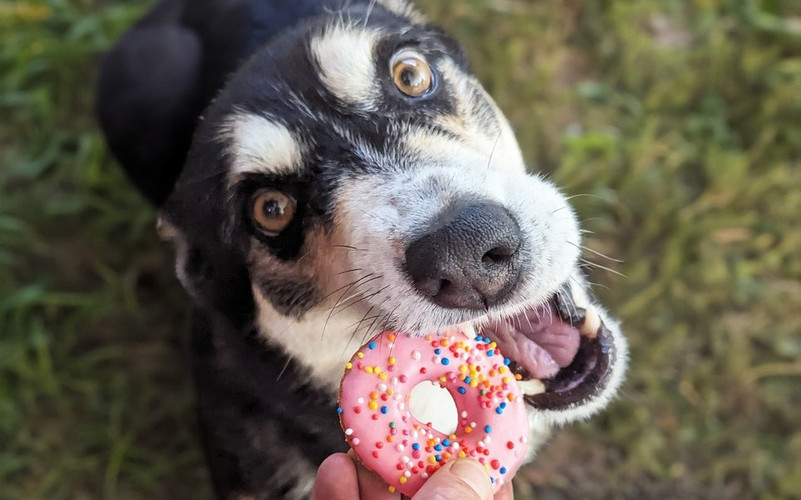
Is Icing Safe for Dogs? Why a Cookie Baked for Dogs Beats Iced Shortbread
Posted by The Huds and Toke Editorial Team on 6th Oct 2026
Put two frosted dog cookies side by side and you often can't tell them apart. Same glossy frosting and same bone shape. Turn the packets over and one is a biscuit baked for dogs, while the other is much closer to shortbread wearing a coat of sugar and fat. Here is what is really under the frosting, what the numbers say, and how to tell the two apart in about a minute.
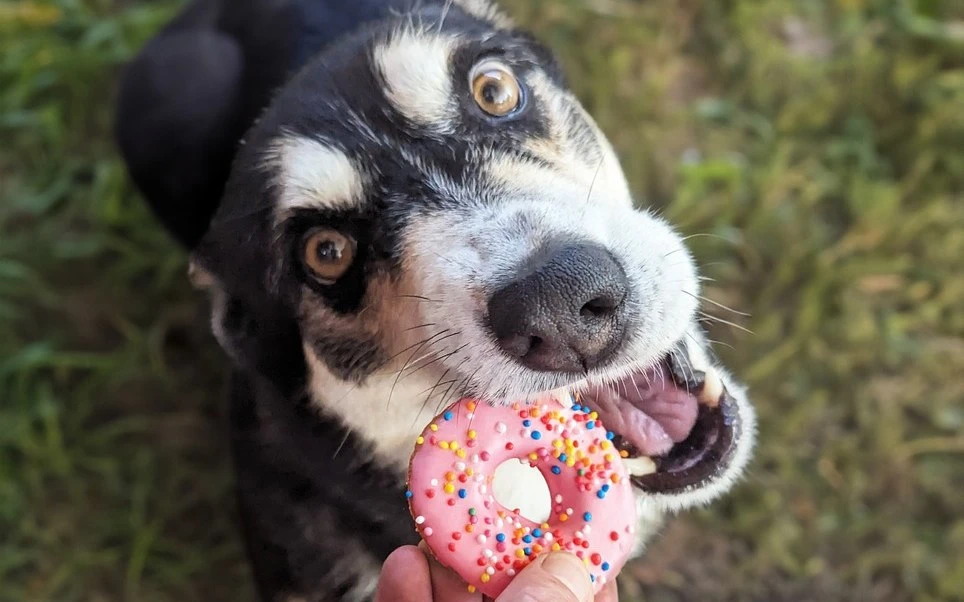
Plain icing is almost pure sugar, and a dog has no use for it. The bigger risks sit around it: "sugar free" icing that can hide xylitol, which is dangerous to dogs, and the fat and kilojoules that pile up when a whole shortbread biscuit is iced or dipped. A cookie baked for dogs, with a frosting designed for dogs, avoids all three.
We should say plainly where we stand. Huds and Toke has been baking dog cookies on Queensland's Sunshine Coast for more than a decade, so we have a dog in this fight. We are not veterinarians. Every figure about our own cookies below is printed on our labels, every other figure links to the source it came from, and where the evidence runs out, we say so rather than stretch it.
The headline findings, in 30 seconds
- Icing is sugar. A classic royal icing sets at roughly 97 to 98% sugar by weight, and icing sugar itself is 100 g of sugars per 100 g in Australia's food composition database.
- Our frosting is not icing. Huds and Toke frosting is not sugar or fat based. It is made in-house to our own proprietary recipe and process, with no added sugar or fat, and it is designed not to melt or smudge, so it won't stain or mark your clothes, furniture or carpets. Being hard, with no added sugar or fat, it is also made to encourage teeth and gum health.
- The coat is only half of it. Shortbread is traditionally one part sugar, two parts butter and three to four parts flour. Coat it and you stack sugar and fat on top of sugar and fat.
- The fat gap is the big one. Our frosted cookies carry 10% crude fat on the label. Our estimate for shortbread with a carob-style coating is about 27.8 g of fat per 100 g, and plain Australian shortbread measures 26.3 g.
- Dogs taste sweet, but they don't need sugar. Dogs have a working sweet receptor, which is exactly why sugar makes a treat appealing. The MSD Veterinary Manual does not count carbohydrate as an essential nutrient for adult dogs.
- "Sugar free" is a reason to check, not relax. Australia's Animal Poisons Helpline lists sugar-free cookies and cakes among the places xylitol turns up.
- Every cookie still counts. Treats should stay under 10% of a dog's daily calories, and that includes ours. Size the cookie to the dog.
In this guide
- Is icing safe for dogs?
- Two very different "dog cookies"
- What icing and coatings are made of
- Side by side: the numbers
- Why fat and sugar matter to a dog
- Inside a Huds and Toke cookie
- How much cookie can my dog have?
- Read a treat label in 60 seconds
- When a wheat cookie isn't right
- Birthdays, gifts and celebrations
- Your questions answered
- The last word
Is icing safe for dogs?
Plain sugar icing is not toxic to dogs, but it isn't food a dog needs either. A lick of birthday cake icing is not an emergency. The problems are what icing is made of, what it is often spread on, and what "sugar free" versions can contain.
Sugar icing: not poisonous, just sugar
The classic hard white icing on biscuits and cakes is royal icing, which Wikipedia describes as a hard white icing "made from softly beaten egg whites, icing sugar (powdered sugar), and sometimes lemon or lime juice". Icing sugar is, as you would expect, sugar. Australia's food composition database, run by Food Standards Australia New Zealand, lists white icing sugar at 100 g of sugars per 100 g. Once a royal icing sets and the egg white's water has gone, our own calculation from the standard recipe puts it at about 97 to 98% sugar by weight.
Does a dog need that? The US-based MSD Veterinary Manual is clear that "dietary carbohydrates are not considered essential nutrients in the diet for adult, nonreproducing dogs and cats". The same chapter adds that "an overload of simple sugars in the GI tract may cause adverse changes in intestinal metabolism, including osmotic diarrhea and flatulence". RSPCA Australia makes a related point, noting that sugary foods "can be associated with metabolic diseases when fed in excess".
The "sugar free" icing trap: xylitol
This is the one that matters most. Xylitol is a sweetener used in place of sugar, and it is dangerous to dogs. Australia's Animal Poisons Helpline puts it bluntly: "Xylitol is a particularly common sugar substitute but unfortunately it can be deadly to dogs." Its list of where xylitol turns up includes "Any baked good (cakes, muffins, cookies, pastries, etc) where xylitol is substituted for sugar".
RSPCA Australia explains why: "xylitol is metabolised differently by dogs", and the resulting hypoglycaemia "can lead to seizures and even death. In some dogs, xylitol consumption causes liver failure and clotting problems". The Helpline also notes it can be labelled "birch sugar or sometimes written as E967". So never treat a human "sugar free" icing, frosting or cookie as a dog-safe swap until you have checked the label for xylitol.
What else hides in human icing and decorations
Butter and cream cheese frostings add a lot of fat. Chocolate icing and chocolate-flavoured coatings contain cocoa, and RSPCA Australia says theobromine in cocoa "is toxic to dogs and other animals at certain doses". Some cheaper coatings are "compound chocolate", which still contains cocoa, so a brown coating is not automatically carob. Our guide on whether dogs can eat carob covers the carob and chocolate difference in detail.
What dog-safe frosting looks like
A frosting made for dogs starts from a different question. Not "how do we make this glossy and sweet?" but "what can sit on a dog biscuit, hold its shape in an Australian summer, and add nothing a dog doesn't need?" Ours is built from low-fat yoghurt powder and carob powder, among some other proprietary ingredients, and the label reads "No added salt, sugar or preservatives". More on exactly what that means, including the honest caveats, further down.
Two very different things sold as a "dog cookie"
The difference isn't the look. It is which species the recipe was written for. One cookie starts from the dog and works backwards. The other starts from the human bakery, gets shaped like a bone, and is given a coat.
The cookie baked for dogs
It begins with a flour dogs digest well, a flavour dogs love, and just enough moisture to bind the dough. RSPCA Australia notes that dogs have evolved from their wolf ancestors, "including developing an ability to digest starch and fat", and MSD reports that dogs digest properly cooked starches "with > 90% efficiency". Researchers in Sweden have tied that ability to extra copies of the pancreatic amylase gene, AMY2B, which varies between breeds and individual dogs. A well-baked flour is a sensible base. Added sugar is not needed.
The shortbread-style biscuit with a coat
Shortbread is traditionally made from "one part white sugar, two parts butter and three to four parts plain wheat flour". Australia's food composition database describes commercial shortbread-style biscuits as ones where "Ingredients may include butter, wheat flour, sugar and rice flour", and measures them at 26.3 g of fat and 20.4 g of sugars per 100 g. Cut that into a bone, then ice it or dip it, and the coat adds a second layer of sugar, fat or both.
A cookie formulated for the species that eats it
Wholemeal base, xylitol-free peanut butter for flavour, a little canola oil, and a frosting of yoghurt powder and carob. Nothing added to please a human palate. 12% protein and 10% fat on the label.
Shortbread with an icing or coating
Butter, flour and sugar underneath. Icing sugar, or a coating of sugar and hard vegetable fat, on top. Not poisonous, but the numbers work out at two to nearly three times the fat and about half the protein.
To be fair to everyone, not every iced dog biscuit is shortbread underneath, and some small bakeries use sugar-free icings too. The point is not that one category is always bad. It is that the look of a cookie tells you nothing, and the label tells you nearly everything.
Plus, if a label doesn't tell you where the cookie is made, for example "Australian Made", you can't be sure where it comes from. If it says "packed for" or "Packaged in Australia" and doesn't say it is Australian Made, there are further questions you should be asking.
What icing and coatings are actually made of
There are two common coats on a decorated biscuit: sugar icing, and a "compound coating" of sugar, hard vegetable fat and milk solids. Both are designed to look good and last on a shelf. Neither was designed around a dog.
What the coat is made of
Per 100 g of the coating itself
Royal icing, set calculated from the classic recipe
Yoghurt confectioner's coating USDA 167569
Carob confection USDA 167973
Generic reference values from USDA FoodData Central (overseas) and a calculation from the standard royal icing recipe, not measurements of any product.
What is a compound coating?
A compound coating is the glossy, snappy coat you see on a lot of confectionery. Wikipedia's entry on compound chocolate explains that it uses "less-expensive hard vegetable fats such as coconut oil or palm kernel oil in place of the more expensive cocoa butter". Yoghurt and carob versions work on the same principle, with milk solids or carob in place of cocoa.
The US Department of Agriculture's composition database gives a sense of what that means per 100 g. A yoghurt confectioner's coating is 62.4 g sugars and 27.0 g fat. A carob confection, despite being labelled "unsweetened" in the database, is 34.1 g sugars and 31.4 g fat, and 29.0 g of that fat is saturated. These are generic US reference values, not measurements of any Australian product, but they show why a coat is rarely a light touch.
Is palm kernel oil bad for dogs?
It isn't toxic. It is simply a very saturated, very energy-dense fat. Palm kernel oil "is semi-solid at room temperature" and is "more saturated than palm oil", and USDA figures put it at 81.5 g of saturated fat per 100 g, against 51.4 g in salted butter. Being semi-solid at room temperature is also why fat-based coatings soften and smudge on a hot Australian day.
Coatings have their place. A little carob or yoghurt drop, given occasionally and counted in the treat budget, is a fine thing for a healthy dog. The problem this article is about is scale: a whole shortbread biscuit, coated all over, handed out as a "healthy" cookie.
Side by side: a cookie baked for dogs vs iced shortbread
On the numbers, the cookie baked for dogs carries less than half the fat, about twice the protein, and fewer kilocalories per 100 g. Our figures are from our own label. The shortbread figures are from Australia's food composition database, and the iced and coated versions are our estimates, built from that data and the USDA's.
| Per 100 g | Huds and Toke frosted cookie | Shortbread, plain | Shortbread + sugar icing | Shortbread + carob-style coating |
|---|---|---|---|---|
| Source | Our label | FSANZ database (F001244), energy recalculated on the dog basis | Estimate: 80% shortbread, 20% royal icing | Estimate: 70% shortbread, 30% carob confection |
| Energy, dog basis | 359 kcal | 458 kcal | 436 kcal | 464 kcal |
| Fat | 10 g | 26.3 g | 21.0 g | 27.8 g |
| Protein | 12 g | 6.2 g | 5.3 g | 6.8 g |
| Sugars | No added sugar (label) | 20.4 g | about 36 g | about 24.5 g |
| What's on top | Yoghurt powder, carob powder, starches, guar gum | Nothing | Icing sugar and egg white | Sugar, hard vegetable fat, milk solids, carob |
Energy per 100 g, dog energy basis
How many kilocalories a dog gets from 100 g
All four on the modified Atwater basis that pet treat labels use. Estimates are built from FSANZ and USDA composition data, not measurements of any product. Bars start at zero.
Why "dog basis"? Human food databases calculate energy one way. Pet food labels state metabolisable energy, usually calculated with the "modified Atwater" factors, which give lower numbers for the same food. Comparing our 359 kcal label against the database's 2110 kJ (about 504 kcal) for shortbread would exaggerate the gap, so every estimate in the chart and table is calculated the way pet labels usually are. On the database's own human basis, shortbread with a carob-style coating comes out at about 515 kcal per 100 g.
One honest limit. This comparison holds against shortbread-style, butter-rich biscuits. A plain hard-baked dog biscuit with a thin dip can be lower in energy than ours, so we are not claiming our cookies are lower in kilojoules than every decorated treat on the shelf. The fat difference against shortbread is the most robust finding, and it is large.
Why the fat and sugar matter to a dog
The Australian Veterinary Association states that "Almost half of dogs and one third of cats in Australia are overweight or obese". That figure traces back to a University of Sydney-led study of 2,661 dogs seen at Australian vet clinics, published in 2005, which found 41 per cent were overweight or obese.
It is also largely in our hands. In a University of Melbourne survey of 153 Victorian vet practices, vets felt 97% of cases came down to human factors "such as diet, exercise and owner attitudes". RSPCA Australia warns that "obesity can lead to other serious health complications such as heart failure and diabetes".
Almost half
of dogs in Australia are overweight or obese, according to the Australian Veterinary Association, citing a 2005 national study.
Rich, fatty food and pancreatitis
Fat matters for another reason. The AVA describes pancreatitis as a condition "which often occurs as a result of eating rich, high-fat foods", and RSPCA Australia notes that feeding fat trimmings "may be associated with the development of pancreatitis". The research picture is more complicated than "fat causes pancreatitis", and the MSD Veterinary Manual says that "For most cases of pancreatitis no specific cause can be identified". We are not suggesting a shortbread biscuit causes it. We are saying vets consistently link rich, fatty food with it, and a cookie doesn't need to be rich to be loved.
Dogs can taste sweet, which is exactly the problem
Unlike cats, dogs have a working sweet taste receptor. A 2005 genetics study found that "dogs have a human-like T1R2 structure" and "an avidity for sweet carbohydrates", while cats have lost the gene. An older study of young beagles found that "Lactose, fructose, and sucrose were well accepted". This means that sugar can make a treat more appealing to a dog, even though it is unhealthy for them. That is palatability, not nutrition, and not in the dog's best interest. It is why a recipe built for dogs should earn its enthusiasm with other ingredients, chosen with the health of the dog in mind, not the ease of manufacture.
What about teeth?
Here we want to be careful, because this is where a lot of articles overclaim. Cavities are uncommon in dogs. In one Canadian veterinary dentist's patient records, "5.25% of adult canine patients had one or more caries lesion", and the same author notes a diet "high in highly refined and easily fermentable carbohydrates will favor the development of caries". An Australian veterinary dental practice puts it practically: "Sticky foods cling to teeth and promote bacterial growth." In dogs, gum disease is the bigger issue. Our read: sugar is not doing your dog's teeth any favours, because the higher the sugar and fat content, the softer the cookie, and a soft cookie made to look like a dog treat is a problem for the reasons above. Hard chews, including hard cookies made for dogs, along with brushing, are ideal for a doggy dental plan.
Inside a Huds and Toke frosted cookie, ingredient by ingredient
Straight off the label, in the order it is printed. This is the recipe shared by our frosted range, including our Sparkle Cookies, Frosted Doggy Bones, Freckle Cookies and Doggy Donuts. Every recipe in our bakery is written for dogs, not adapted from a human one.
| Ingredient | Why it's there |
|---|---|
| Whole wheat flour | The biscuit itself. Wholemeal rather than white. See wheat below. |
| Peanut butter (no xylitol) | Flavour dogs love. Xylitol-free is non-negotiable. RSPCA Australia advises owners to "Always check peanut butter for xylitol if you plan on using it as a treat." |
| Canola oil | A small amount to bind the dough. A plant oil that is liquid at room temperature. |
| Apple cider vinegar | A baking ingredient in the dough. |
| Yoghurt powder (low fat) | The base of the frosting. |
| Potato starch and tapioca starch | Part of the biscuit dough, alongside the flour. |
| Carob powder | Colour and flavour in the brown frostings, in place of chocolate. |
| Calcium carbonate and guar gum | Guar gum is a plant-based thickener. |
| Sprinkles, coconut, colours | The decoration. |
The label reads "No added salt, sugar or preservatives", with 12% crude protein, 10% crude fat and 359 kcal per 100 g. It is also built to hold its shape in warm weather, which is the thinking behind our no-melt frosting. It won't smudge on your carpet, lose its shape in hot weather or leave stains on your clothes.
The honest bit about sugar. "No added sugar" is not the same as "no sugar", and we won't pretend otherwise. Carob powder is naturally sweet (USDA figures put carob flour at 49.1 g of natural sugars per 100 g), and yoghurt powder contains milk sugar. Food Standards Australia New Zealand makes the same point about human food: "Products with 'no added sugar' nutrition content claims may still contain high levels of naturally occurring sugars." In our frosted cookies, carob powder is listed after the flour, peanut butter, oil, vinegar, yoghurt powder and starches, meaning there is very little of it in the actual cookie. It is still a treat.
The frosted range
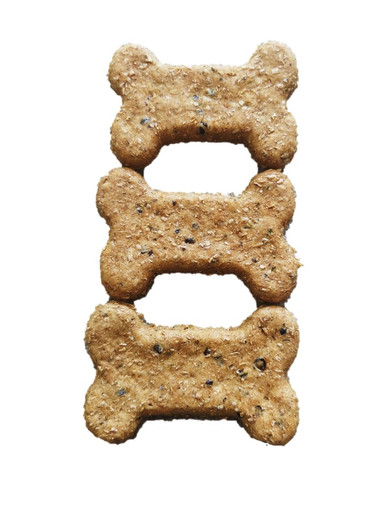
Cookies designed for dogs
Our cookies are hard baked for dental benefits, with a hard, no-melt frosting that makes them look awesome in photos, protects you from nasty stains from smudging and melting, and gives your dog an extra crunch. Plus, it's fun to have pretty things!


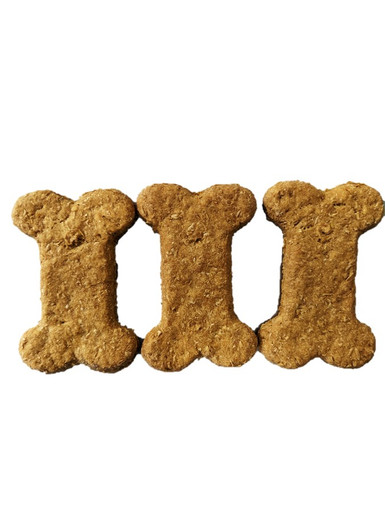
Prefer no frosting at all? Our peanut butter cookies use the same dog-first base with nothing on top: whole wheat flour, xylitol-free peanut butter, canola oil, apple cider vinegar, potato and tapioca starch and bicarbonate soda.
No frosting at all
Peanut butter cookies, nothing on top
The same dog-first base, baked plain. The simplest cookies we make.


How much cookie can my dog have?
Treats of every kind should stay under 10% of your dog's daily calories. The World Small Animal Veterinary Association's Global Nutrition Committee says "Treats should always make up less than 10% of a dog's daily calorie intake." Its guide suggests about 47 kcal of treats a day for an average healthy 10 kg adult dog.
The 10 percent treat budget
How many grams of cookie a healthy adult dog can have a day
4 kg dog up to 24 kcal of treats a day
10 kg dog up to 47 kcal of treats a day
20 kg dog up to 79 kcal of treats a day
30 kg dog up to 108 kcal of treats a day
Treat kcal from the WSAVA Global Nutrition Committee guide (2024) for an average healthy adult dog in ideal body condition. Grams use 359 kcal per 100 g (our label) and 464 kcal per 100 g (estimate). Your Australian vet can give you your own dog's number.
That chart turns the WSAVA figures into grams. A 10 kg dog's daily pet treat allowance is about 13 g of our frosted cookie, or about 10 g of shortbread with a carob-style coating. Put another way, the same allowance buys about 30% more of the cookie baked for dogs. You can always manage your dog's intake by breaking larger cookies into pieces and sharing them over a few days.
If you like doing the maths yourself, MSD calculates a dog's resting energy requirement as 70 multiplied by its body weight in kilograms raised to the power of 0.75, and lists 1.6 times that figure for a neutered (desexed) adult. For a 10 kg dog that is about 630 kcal a day, and 10% is about 63 kcal, a little more generous than WSAVA's table. MSD also notes that any given animal may need "as much as 30% more or less of the calories calculated". Your Australian vet can give you the right number for your own dog.
Daily calorie budget
In plain English: treats are the garnish, not the meal. WSAVA puts it simply: "Treats should never replace a meal". If cookie day is a big day, trim the other treats.
How to read a dog treat label in 60 seconds
Turn the packet over and check seven things: the first ingredients, sugar, fat, sweeteners, salt, the analysis panel and who made it. It takes about a minute, and it tells you far more than the photo on the front.
- Read the first three ingredients. Many Australian pet food labels are written to Australian Standard AS 5812, and the Pet Food Industry Association of Australia says "The Standard advises that pet food labels list the ingredients (with the exception of water) in descending order (by weight)". The first few ingredients are what the treat mostly is.
- Look for sugar under its other names. Australia's food code, which applies to human food but makes a handy checklist, counts dextrose, glucose syrups, maltodextrin, molasses and icing sugar among its "sugars". Honey is another common one.
- Find the fat. Palm kernel oil, vegetable fat, hydrogenated oil or butter sitting high on the list, next to sugar, usually means a coating or a shortbread base.
- Check the sweetener. Xylitol, birch sugar or E967 means put it back. It is poisonous to dogs.
- Look for added salt. Check whether salt appears in the ingredient list, and compare the salt figure on the analysis panel if there is one.
- Read the analysis panel. Compare crude fat and kcal per 100 g, not per pack or per piece. Pieces vary wildly in size.
- See who made it, and where. A maker's name and an Australian contact address you can actually reach are a good sign.
Try it on the packet in your hand
The 60-second label checker
Grab any dog cookie, turn the packet over and tick each check the label passes.
A guide to reading a label, not a health assessment. For comparison, our own frosted cookie label reads 12% crude protein, 10% crude fat and 359 kcal per 100 g, with no added salt, sugar or preservatives.
Pet food in Australia is overseen by the states. The Department of Agriculture says "States and territories have primary responsibility for overseeing the manufacture and sale of pet food in Australia", and on 24 April 2026 agriculture ministers "agreed that a regulatory approach is not warranted at this time". That makes reading the label yourself more useful, not less.
When a wheat cookie isn't the right cookie
Our frosted cookies are made with whole wheat flour and yoghurt powder, so they are not the answer for a dog with a diagnosed wheat or dairy allergy. Worth keeping in proportion, though. An international review found that among dogs presented to a vet for any reason, the prevalence of food allergy affecting the skin was "1 to 2%". Among 297 dogs that already had a diagnosed food allergy, the most commonly reported triggers were beef (34%), dairy (17%), chicken (15%) and wheat (13%).
That is 13% of allergic dogs, not 13% of all dogs. It is also worth noticing that shortbread contains both wheat and butter, so it is no escape from either. If your vet has confirmed a wheat allergy, our grain-free dog treats and wheat-free range are worth a look, but check every ingredient with your vet first, because some grain-free recipes still include dairy or cheese.
No wheat in the recipe
Grain-free cookies
Made without grains. If your dog has a diagnosed allergy, check every ingredient on the label with your vet first.


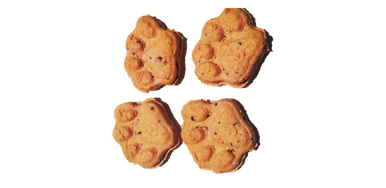
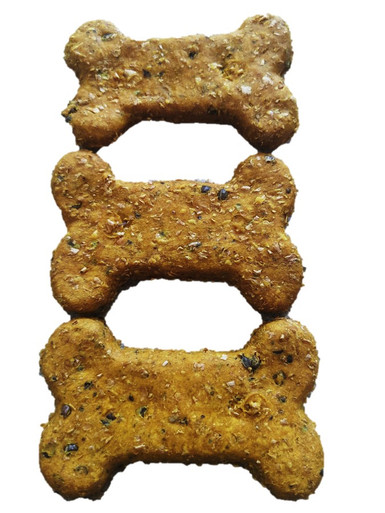
Want something with a little more going on? Our hemp cookies use wholemeal flour and hemp seed meal with real mackerel and spinach, or turkey, chicken and turmeric.
Something different
Hemp seed cookies with real fish or meat
Wholemeal flour and hemp seed meal with mackerel and spinach, or turkey, chicken and turmeric. No added salt, sugar or preservatives on the label.
Birthdays, gift boxes and celebration cookies
A decorated cookie is celebration food, and that is exactly how we'd like you to use ours. Birthdays, gotcha days, Christmas stockings, a thank-you for the dog walker. The point of baking them for dogs is that a special day doesn't have to come with a shortbread-sized helping of fat and sugar.
A few tips from our kitchen. Break big cookies into pieces for small dogs. Count the cookie in the day's treat budget. At a dog party, keep the human cake well out of reach, and our dog birthday party guide has the rest. The University of Sydney's Dr Anne Fawcett warns that "A sudden influx of fatty festive foods can wreak havoc on their gut", which is worth remembering every December.
For celebrations
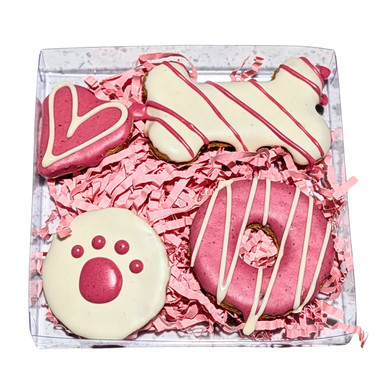
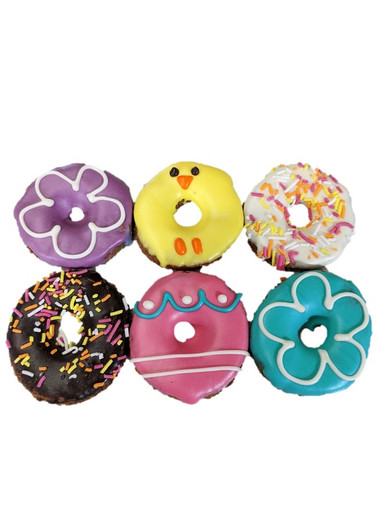
Gift boxes of cookies baked for dogs
Hand-decorated cookies boxed for birthdays, gotcha days and thank-yous. Same dog-formulated base inside.
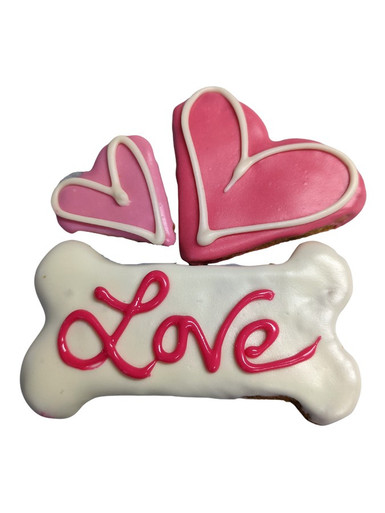
For more gifting ideas, see our guide to dog gift boxes and hampers, or browse the full dog bakery and dog birthday cakes.
Is icing safe for dogs? Your questions answered
The questions we're asked most, answered short. If your dog has eaten something with xylitol or a lot of chocolate, stop reading and ring your Australian vet or the Animal Poisons Helpline on 1300 869 738.
Can dogs eat icing?
A small lick of plain sugar icing isn't toxic, but dogs don't need it. Icing is almost entirely sugar, and the MSD Veterinary Manual says carbohydrates are not essential nutrients for adult dogs. Avoid chocolate icing, butter-rich frostings, and any sugar-free icing, which can contain xylitol. If you want to decorate for your dog, choose a frosting made for dogs.
Is icing sugar toxic to dogs?
No, icing sugar is not toxic to dogs. It is simply sugar, listed at 100 g of sugars per 100 g in Australia's food composition database. The concern is quantity and habit, because extra sugar adds kilojoules and, according to RSPCA Australia, sugary foods can be associated with metabolic diseases when fed in excess. Sugar-free icing mixes are the ones to check for xylitol.
What icing is safe for dogs?
Icing made for dogs, with no xylitol, chocolate or added sugar. Our frosting uses low-fat yoghurt powder and carob powder, among other proprietary ingredients, and our label reads no added salt, sugar or preservatives. Carob and yoghurt carry some natural sugars, so it is still a treat. Keep it inside the 10% treat allowance.
Can dogs eat shortbread?
A crumb won't hurt, but shortbread is human food. It is traditionally one part sugar, two parts butter and three to four parts flour, and Australian commercial shortbread measures 26.3 g of fat per 100 g. Vets link rich, fatty foods with pancreatitis. If your dog ate a lot of shortbread, or a chocolate-coated one, call your Australian vet. Plus, they are soft biscuits, so they have very little, if any, dental benefit.
What should I look for in a yoghurt frosted dog treat?
It's all about the fat content and how much yoghurt is included. Check the fat figure on the label and where yoghurt sits in the ingredient list. Our frosted cookies use low-fat yoghurt powder and carry 10% crude fat on the label.
Is palm kernel oil bad for dogs?
Palm kernel oil isn't toxic to dogs, but it is a very saturated, energy-dense fat. USDA figures list 81.5 g of saturated fat per 100 g, compared with 51.4 g in salted butter. It is used in coatings because it is semi-solid at room temperature. A little on an occasional treat is fine. A whole biscuit coated in it adds up quickly.
Are carob and yoghurt dog treats good for dogs?
Carob is safe for dogs because it contains none of the caffeine and virtually none of the theobromine that make chocolate toxic to dogs. What matters is the rest of the recipe and how much your dog eats. A thin frosting on a dog biscuit and a whole biscuit dipped in coating are very different amounts. Read the label, and keep all treats under 10% of daily calories. Plus, make sure the dog treat is firm, so it can provide dental benefits. Soft is bad and hard is good for dogs, which is different for humans.
Is peanut butter in dog treats safe?
Peanut butter is fine for most dogs in moderation, as long as it does not contain xylitol. RSPCA Australia advises owners to always check peanut butter for xylitol, and the Animal Poisons Helpline lists peanut butter among the spreads where it can turn up. Our cookies use peanut butter with no xylitol.
What ingredients should I avoid in dog treats?
Never feed xylitol (also sold as birch sugar or E967), chocolate or cocoa, macadamias, grapes or sultanas. Beyond those, be wary of treats where sugar, icing sugar, glucose syrup or palm kernel oil sit near the top of the ingredient list. Pet food labels following AS 5812 list ingredients in descending order by weight, so the first few tell the story.
How many cookies can my dog have a day?
Work in calories, not cookies. WSAVA says treats should make up less than 10% of daily calories, about 47 kcal a day for an average healthy 10 kg adult dog. At 359 kcal per 100 g, that is roughly 13 g of our frosted cookie. Break big cookies into pieces for small dogs, and ask your Australian vet for your own dog's number.
The last word
From across the room, a frosted cookie baked for dogs and an iced shortbread look almost identical. The difference is underneath: which species the recipe was written for. One is a wholemeal, peanut butter biscuit with a yoghurt and carob frosting and no added sugar, salt or preservatives, baked firm to help with dental benefits. The other is sugar, butter and flour with more sugar, or sugar and hard fat, poured over the top, and soft to chew, which does not provide any benefits for your dog's dental health. Your dog will happily eat either. Only one of them was made with your dog in mind.
Whichever you buy, read the label, skip anything with xylitol, count every cookie in the day's treats, and check with your Australian vet if your dog has a weight, pancreas or allergy concern.
Plus, where you can, be sure the label says "Made in Australia". This gives you confidence in the quality and helps Australian businesses, which are run by people. So it helps people as well as their pets!
Cookies baked for dogs, frosted by hand on the Sunshine Coast
Our frosted cookies are made for the species that eats them: a wholemeal peanut butter base, a no-melt yoghurt and carob frosting, and no added salt, sugar or preservatives on the label. They are baked firm to the touch, with dental and gum health in mind. Built for celebrations, sized for sharing.
Browse our healthy dog cookiesReferences
- Australian Veterinary Association, Vet Voice. Obesity in Australian pets. vetvoice.com.au
- Australian Veterinary Association, Vet Voice (2019). What not to feed your dog. vetvoice.com.au
- RSPCA Australia Knowledgebase. What are common household dangers for pets? kb.rspca.org.au
- RSPCA Australia Knowledgebase. What should I feed my dog? kb.rspca.org.au
- RSPCA Australia Knowledgebase. How do I tell if my dog is overweight? kb.rspca.org.au
- RSPCA Australia Knowledgebase. Why is chocolate toxic to dogs and other animals? kb.rspca.org.au
- RSPCA Australia. Spring cleaning? 6 pet dangers to throw out and avoid. rspca.org.au
- Animal Poisons Helpline (2021). Xylitol, ABCs of poisons. animalpoisons.com.au
- Animal Poisons Helpline (2022). The Xylitol Project. animalpoisons.com.au
- McGreevy PD, Thomson PC, Pride C, Fawcett A, Grassi T, Jones B (2005). Prevalence of obesity in dogs examined by Australian veterinary practices and the risk factors involved. Veterinary Record 156(22):695-702. PubMed
- Bland IM et al (2010). Dog obesity: veterinary practices' and owners' opinions on cause and management. Preventive Veterinary Medicine 94:310-315. PubMed
- University of Sydney (2017). Three reasons you shouldn't feed Christmas ham to your dog. sydney.edu.au
- Food Standards Australia New Zealand. Australian Food Composition Database: F001244 Biscuit, sweet, shortbread style, commercial; F008980 Sugar, white, icing. F001244, F008980
- Food Standards Australia New Zealand. Sugar. foodstandards.gov.au
- Food Standards Australia New Zealand (2021). Review of nutrition labelling for added sugars, Appendix 1. PDF
- Pet Food Industry Association of Australia. Understanding pet food labels. pfiaa.com.au
- Department of Agriculture, Fisheries and Forestry. Pet food safety. agriculture.gov.au
- Advanced Animal Dentistry (Australia). Pet diet and oral health. animaldental.com.au
- Sanderson SL. Nutritional Requirements of Small Animals. MSD Veterinary Manual (overseas). msdvetmanual.com
- Steiner JM. Pancreatitis and Other Disorders of the Pancreas in Dogs. MSD Veterinary Manual (overseas). msdvetmanual.com
- WSAVA Global Nutrition Committee (2024). Feeding treats to your dog (international). PDF
- Li X et al (2005). Pseudogenization of a sweet-receptor gene accounts for cats' indifference toward sugar. PLoS Genetics 1(1):e3 (overseas). PLoS
- Ferrell F (1984). Preference for sugars and nonnutritive sweeteners in young beagles. Neuroscience and Biobehavioral Reviews 8(2):199-203 (overseas). PubMed
- Arendt M, Fall T, Lindblad-Toh K, Axelsson E (2014). Amylase activity is associated with AMY2B copy numbers in dog. Animal Genetics 45(5):716-722 (overseas). PubMed
- Hale FA (2009). Dental caries in the dog. Canadian Veterinary Journal 50(12):1301-1304 (overseas). PMC
- Olivry T, Mueller RS (2017). Critically appraised topic on adverse food reactions of companion animals (3): prevalence of cutaneous adverse food reactions in dogs and cats. BMC Veterinary Research 13:51 (overseas). PubMed
- Mueller RS, Olivry T, Prélaud P (2016). Critically appraised topic on adverse food reactions of companion animals (2): common food allergen sources in dogs and cats. BMC Veterinary Research 12:9 (overseas). PMC
- US Department of Agriculture, FoodData Central (overseas): 167569 confectioner's coating, yogurt; 167973 carob candy; 171422 palm kernel oil; 173410 butter, salted; 173755 carob flour; 172183 egg white. 167569, 167973, 171422, 173410, 173755, 172183
- Wikipedia. Shortbread; Royal icing; Compound chocolate; Palm kernel oil; Xylitol. Shortbread, Royal icing, Compound chocolate, Palm kernel oil, Xylitol
- Huds and Toke product labels: Carob and Yoghurt Frosted Sparkle Cookies, Nutty Paws Dog Cookies (accessed 17 September 2026). Sparkle Cookies, Nutty Paws
Huds and Toke: Proudly Australian, Family Owned
Huds and Toke is a family-owned Australian premium pet treats company, based on Queensland's Sunshine Coast. Naturally made here in Australia and loved by pets and their people right across the country.
Learn more on Wikipedia · Our story · Awards and recognition