
Can Dogs Eat Apples? Seeds, Cores, Skin and How Much Is Safe
Posted by The Huds and Toke Editorial Team on 16th Oct 2026
Can dogs eat apples? Yes. Plain apple flesh is not on RSPCA Australia's list of foods that are toxic to dogs, but fruit seeds are, so take out the core and seeds and give a few thin slices as a treat. Keep apple, with every other treat, under 10% of the day's calories, a rule from the World Small Animal Veterinary Association (overseas). Keep dogs away from rotten windfalls.
By The Huds and Toke Editorial Team, Coolum Beach, Queensland. 14 minute read. Published 16 October 2026.

Below: what the sources say about seeds, cores and skin, how much apple suits your dog's size, and a short word on horses and cats. Australian sources come first and overseas ones are marked.
In this guide: The short answer | Seeds | Core | Skin | Green or red | How much | Calculator | Horses | Questions
Can dogs eat apples?
Apple flesh is not on the toxic food list of RSPCA Australia, which does list fruit seeds and fruit stones. Nor is apple on the toxic food list of the World Small Animal Veterinary Association (WSAVA, overseas), which names chocolate, macadamia nuts, onions and their relatives, grapes and dried vine fruit, xylitol, alcohol and raw yeast dough, and caffeine. The fruit the Australian Animal Poisons Helpline warns about for dogs on its home page is grapes, raisins and sultanas, which can cause kidney injury.
The overseas ASPCA Animal Poison Control page for apple does say "Toxic to Dogs", and that is the line that worries people. Read on and the toxic parts it names are the stems, leaves and seeds, which contain cyanide-forming compounds. It says nothing against the flesh.
RSPCA Australia's own treat advice includes "an appropriate and safe morsel of human food", and it says the basis of a dog's diet should be a complete commercial food suited to its life stage. A few slices of apple fit that description. A bowl of it does not.
Apple, part by part
For dogs. Sources are in the sections below.
| Part | What the sources say | What we do |
|---|---|---|
| Flesh | Not on RSPCA Australia's or WSAVA's lists of foods toxic to dogs | Thin slices, as a treat |
| Skin | Not one of the parts ASPCA lists as toxic | Fine to leave on |
| Seeds | RSPCA Australia lists fruit seeds as toxic to dogs | Take them out |
| Core | Holds the seeds and the stem | Cut it out |
| Stem and leaves | ASPCA: contain cyanide, particularly while wilting | Keep dogs off them |
| Rotten or mouldy apples | RSPCA Australia lists mouldy or spoiled food and compost as toxic | Pick up windfalls |
The 26 second version: core it, slice it, keep it a treat. Watch on YouTube.
Are apples good for dogs?
No authority we checked makes a health claim for apples in dogs, so we will not make one either. What the figures do show is that apple is a light treat.
In the Australian Food Composition Database, 100 g of red apple with the skin on is 83.2 g of water and carries 242 kJ (about 58 kcal), 12.4 g of sugars and 2.5 g of fibre. The USDA's figures (overseas) put the fat at 0.17 g per 100 g. Gram for gram, that is under a fifth of the energy in our own Veggie Tubes, which are 320 kcal per 100 g on the label.
That is the honest case for apple: mostly water, a little sugar, almost no fat, and a crunch many dogs enjoy. It is still a treat and not a food: WSAVA says treats should never replace a meal, because every dog needs a complete and balanced diet. If your dog has a medical condition or is on a vet-prescribed diet, WSAVA advises asking your veterinary team what is suitable before giving any treat. In Australia, that means your Australian vet.
What will happen if my dog ate apple seeds?
Can dogs eat apple seeds?
Apple seeds contain amygdalin, a natural compound that plant enzymes can break down to release hydrogen cyanide. A University of Leeds study (overseas) measured 1 to 4 mg of amygdalin per gram of seed across 15 apple varieties. In an earlier study by the same team, seeds from the rose family (Rosaceae), the plant family apples belong to, held far more than the other seeds tested: 0.1 to 17.5 mg per gram, against 0.01 to 0.2 mg for seeds from other plant families.
The overseas MSD Veterinary Manual gives the lethal dose of hydrogen cyanide for most animals as about 2 mg per kg of body weight, and notes that seeds and leaves typically hold more than the fleshy part of a fruit. It also says dogs have lower activity of the enzyme the body uses to clear cyanide than other species.
How many seeds would it take?
We did the sum from those published figures. A 10 kg dog would need about 20 mg of hydrogen cyanide to reach that lethal level. By its chemistry, each gram of amygdalin can release at most about 59 mg of hydrogen cyanide. If every seed were fully crushed and gave up all of its cyanide, that is about 85 g of apple seed at the top of the Leeds range, or about 340 g at the bottom. An Adelaide vet clinic, Walkerville Vet, weighed the seeds from seven apples at 3 g, under half a gram an apple. On that weighing, 85 g of seed is the seeds of roughly 200 apples.
Three cautions keep that number honest. It is an estimate of a lethal amount, not a safe dose, and a dog can be unwell on much less. It assumes every seed is chewed to a powder and gives up all its cyanide. And it is not a reason to feed seeds. Walkerville Vet's view is that sensible amounts of apple cores and seeds are harmless to dogs; RSPCA Australia still lists fruit seeds among the foods never to feed. We side with RSPCA. Coring an apple takes ten seconds.
So if your dog has swallowed the seeds from an apple or two, a serious poisoning is very unlikely on these figures. The signs ASPCA (overseas) lists for the cyanide in apple stems, leaves and seeds are brick red mucous membranes, dilated pupils, difficulty breathing, panting and shock. If you see any of them, or your dog has eaten a large amount of seeds or cores, ring your Australian vet or the Animal Poisons Helpline on 1300 869 738. The Helpline is a 24/7 paid service, with consultations from $75, staffed by consultants with experience as senior emergency vets or clinical pharmacists.
Can dogs eat apple middle?
Can dogs eat apple core?
The core is where the seeds and the stem are, the parts ASPCA (overseas) names as toxic. That alone is reason enough to cut it out.
We could not find a veterinary source that names apple cores as a cause of blockages in dogs, so we will not claim it. WSAVA's general advice is that any treat should be an appropriate size and shape to reduce the risk of choking. RSPCA Australia also lists "roughly-cut vegetables" among things that can be dangerous for dogs. It does not mention apple, but we cut apple the same way: thin slices, core out.
If your dog has stolen a whole core, watch them, and ring your Australian vet if anything seems wrong.
Can dogs eat apple skin?
Yes. Skin is not one of the parts ASPCA lists as toxic. Peeling makes little difference to the numbers: in the Australian food data, red apple is 242 kJ per 100 g with or without the skin, and sugars go from 12.4 g to 12.7 g. What peeling does remove is fibre, which drops from 2.5 g to 1.8 g. Wash it as you would for yourself and leave it on.
Green, red, Granny Smith
Can dogs eat green apples?
Yes, the same rules apply: core out, seeds out, small amounts. Green apples are slightly lighter. In the Australian food data, Granny Smith is 208 kJ and 10.6 g of sugars per 100 g, against 242 kJ and 12.4 g for red apple. The difference is small enough that the best apple for your dog is the one already in your fruit bowl.
Australian apples, per 100 g
| Apple (raw, skin on) | kJ | kcal | Sugars g | Fibre g |
|---|---|---|---|---|
| Red skin, unpeeled | 242 | 58 | 12.4 | 2.5 |
| Green skin, unpeeled | 212 | 51 | 11.1 | 2.5 |
| Granny Smith | 208 | 50 | 10.6 | 2.5 |
| Pink Lady | 242 | 58 | 12.2 | 3 |
| Royal Gala | 222 | 53 | 11.1 | 2.1 |
| Fuji | 245 | 59 | 12.1 | 2.4 |
| Red Delicious | 248 | 59 | 13 | 2.3 |
| Golden Delicious | 217 | 52 | 11.6 | 2.4 |
Figures per 100 g from Food Standards Australia New Zealand, Australian Food Composition Database Release 3. We converted kJ to kcal at 4.184.
If it is a Pink Lady, it is the most common apple in the country: the growers' body Aussie Apples says the Cripps Pink variety is now the most widely grown nationally, at close to a third of production. Picking runs from February to June, and growers keep apples in cold storage with a controlled atmosphere between harvests. Queensland's apples all come from the Granite Belt around Stanthorpe.
How much apple can a dog eat?
The working rule is WSAVA's (overseas): treats should make up less than 10% of a dog's daily calories, and that 10% covers every treat, apple included. We found no Australian authority that publishes its own version of the rule.
WSAVA's table gives a 10 kg adult dog 47 kcal of treats a day. As fresh red apple, that is about 81 g, around half of a medium apple, if nothing else were given as a treat.
If the whole treat allowance were apple
Grams of cored apple, fresh, with skin on, a day.
| Dog's weight | WSAVA treat ceiling | As red apple | As Granny Smith |
|---|---|---|---|
| 2 kg | 14 kcal | 24 g | 28 g |
| 4 kg | 24 kcal | 41 g | 48 g |
| 6 kg | 32 kcal | 55 g | 64 g |
| 8 kg | 40 kcal | 69 g | 80 g |
| 10 kg | 47 kcal | 81 g | 95 g |
| 15 kg | 64 kcal | 111 g | 129 g |
| 20 kg | 79 kcal | 137 g | 159 g |
| 25 kg | 94 kcal | 163 g | 189 g |
| 30 kg | 108 kcal | 187 g | 217 g |
| 35 kg | 121 kcal | 209 g | 243 g |
| 40 kg | 134 kcal | 232 g | 270 g |
| 45 kg | 146 kcal | 252 g | 294 g |
The ceiling is WSAVA's table for an average healthy adult dog in ideal body condition (overseas), and it covers all treats, not apple alone. By our arithmetic the table works out at about 1.2 times resting energy, a fairly quiet adult, which is why the calculator below can give a higher figure for a desexed adult.
Most dogs get other treats as well, so the calculator below lets you set how much of the day's allowance goes to apple. It also works out your dog's daily calories from weight and life stage, rather than using WSAVA's single table.
Work it out for your dog
How much apple can my dog have?
Daily calories use the MSD Veterinary Manual's resting energy formula (70 x body weight in kg to the power 0.75) and its multipliers for each life stage (overseas). MSD says any dog may need as much as 30% more or less than the sum gives, so treat it as a starting point. The 10% ceiling is WSAVA's (overseas) and covers every treat in the day, ours included. Apple energy is from Food Standards Australia New Zealand's food composition data, converted from kJ at 4.184 kJ per kcal. A cup of apple slices weighs 109 g in the USDA's data (overseas); we found no standard weight for a single slice, so the tool does not count slices. Veggie Tubes are 320 kcal per 100 g on our label. Weigh the apple after coring. For your own dog, ask your Australian vet.
Can puppies eat apples?
Puppies need the same care with seeds: RSPCA Australia's puppy feeding page repeats fruit seeds and fruit stones on its list of foods not to feed. Puppies also need more energy for their size: the MSD manual puts them at 3 times resting energy under 4 months and 2 times after that, which the calculator uses. A puppy's diet should be built on a complete puppy food. A sliver of apple is a treat, nothing more, and your Australian vet is the person to ask about a young puppy.
Dried apple, apple sauce and apple cider vinegar
Dried apple is a different treat. In the Australian food data it is 1,078 kJ and 59.4 g of sugars per 100 g, between four and five times fresh red apple, gram for gram, because the water has gone. The USDA's figure (overseas) for dried apple is close, at 243 kcal and 57.19 g of sugars per 100 g. By our sums, 10 g of dried apple is about 26 kcal, more than half of WSAVA's daily treat ceiling for a 10 kg dog. So: a piece or two, not a handful.
Unsweetened apple sauce is lighter, at 42 kcal and 9.39 g of sugars per 100 g in the USDA's data (overseas). Read the label of anything sold as sugar free, because xylitol is on WSAVA's list of foods toxic to dogs.
On apple cider vinegar we found no reliable veterinary source either way, so we make no claim for it. It is an ingredient in 14 of our in-stock treats, there for the recipe rather than as a health claim.
Windfalls and rotten apples
Fallen apples under a backyard tree are the real hazard. RSPCA Australia lists mouldy or spoiled food and compost as toxic to dogs. Rotting apples can also make alcohol: a peer-reviewed review from Italy lists rotten apples among the reported causes of ethanol poisoning in dogs. In one published case, described in a review by an ASPCA toxicologist (overseas), a dog that ate a large amount of rotten apples had vomiting, wobbliness, tremors and dehydration, and died 48 hours later. ASPCA adds that apple leaves and stems are particularly toxic while wilting. Pick up windfalls, fence off the compost, and keep fallen leaves raked in autumn.
Can horses eat apples?
Yes, cut up. Texas A&M's vet school (overseas) says apples should be cut into pieces because a whole apple is the right size to lodge in a horse's oesophagus and cause choke. Penn State Extension (overseas) also says to cut apples into slices, and that this matters especially for older horses, whose teeth decline.
Can you give whole apples to horses?
No. Both of those vet and university sources say to cut them up first, and choke means food stuck in the horse's oesophagus so that it cannot swallow food or water.
How many apples a day can you give a horse?
We found no Australian source with a number. The only figure we found, from Penn State Extension (overseas), says to consider the weight of your horse or pony, but that one to two is generally acceptable, without saying one to two of what or how often. Texas A&M's advice is to keep apple an infrequent, unexpected reward.
What fruits should horses not eat?
For horses with equine metabolic syndrome (EMS), the European ECEIM consensus statement says fruit and vegetables such as carrots and apples, and treats, should be left out of the diet because of their sugar and starch content. The MSD manual (overseas) says that for every horse with EMS, treats should be eliminated. Our position is the same: horses with EMS, PPID or laminitis get no treats, ours included. ASPCA's horse plant list (overseas) includes apple too, for the stems, leaves and seeds.
RSPCA Australia puts the sugar problem simply: most horses will choose high sugar feed if given the chance, and it is much better for a horse to eat lots of low calorie food than a little high calorie food. Its laminitis page says fat ponies and their crosses are most predisposed, and that over-feeding fat ponies is a very common cause, particularly in spring after rain.
For more on sugar in horse treats, see our guides to molasses for horses and treats for laminitic horses, or browse our horse treats.
Can cats eat apples?
A taste of plain flesh is not on the toxic lists, but the same parts apply: ASPCA (overseas) lists apple as toxic to cats for its stems, leaves and seeds, and RSPCA Australia puts fruit seeds and fruit stones on its list of foods not to feed cats. RSPCA adds that other foods should only be occasional treats, not the main part of the diet. We found no source saying cats benefit from apple. For cats, our cat treats are a better bet.
Apple dog treats
Apple in our treats
Three of our treats list real apple as an ingredient, not only apple cider vinegar.
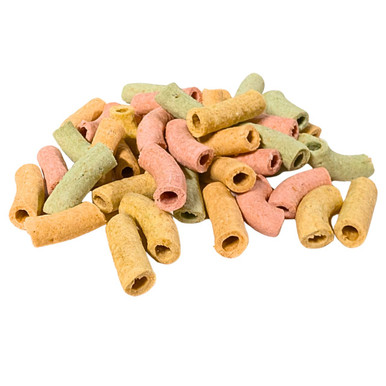


Veggie Tubes. Vegetarian training treats. The label lists: Whole Flour, Oats, Rice, Australian Apple, Australian Carrot, Corn, Australian Beetroot, Apple Cider Vinegar, Turmeric, Natural Colour. They are 3.34% fat and 320 kcal per 100 g, and they sit in our low fat dog treats range. Small pieces suit training.
Golden Paws. Grain-free cookies. The label lists: Tapioca Starch, Vegetable Protein, Coconut Flour, Canola Oil, Apple Cider Vinegar, Apple, Cheese Powder, Turmeric and Black Pepper. They are 375 kcal per 100 g, so they count against the same 10% allowance as apple does.
Calm O's. A horse treat made with whole apple. The label lists: Whole Wheat Flour, L-Tyrosine, Whole Apple, L-Theanine, Sugar, Canola Oil, Apple Cider Vinegar, Salt, Tapioca Starch. Because the label lists sugar, they are, like every treat, not for horses with EMS or laminitis.
What is on our apple labels
| On the label | Veggie Tubes | Golden Paws | Calm O's |
|---|---|---|---|
| Apple on the label | "Australian Apple" | "Apple" | "Whole Apple" |
| For | Dogs | Dogs | Horses |
| Protein | 9.14% | 11.6% | 9.2% |
| Fat | 3.34% | 9.9% | 10.9% |
| Energy, kcal per 100 g | 320 | 375 | Not on the label |
| Pack sizes | 100 g, 1 kg | 100 g, 200 g, 500 g | 3 pieces, 10 pieces, 20 pieces |
| Price from | $5.50 | $10.65 | $12.00 |
Figures as printed on each nutrition panel. Prices are for the smallest pack, as listed on 16 October 2026.
More plant-based options are in our vegetable based dog treats, and our guide to Aussie foods for dogs ranks other things from the pantry.
Quick answers
Apples and pets: common questions
Can dogs have apples?
Yes, as a small treat with the core and seeds removed. RSPCA Australia lists fruit seeds, not apple flesh, as toxic to dogs.
Can dogs eat apple middle?
Cut it out. The middle holds the seeds and stem, which ASPCA (overseas) names as the toxic parts of the apple.
What will happen if my dog ate apple seeds?
A few swallowed seeds are very unlikely to poison a dog: by our arithmetic from published figures, a 10 kg dog would need about 85 g or more of fully chewed seed to reach the published lethal dose of cyanide, and one apple holds under half a gram. That is not a safe dose: a dog can be unwell on less. If your dog ate a lot, or seems unwell, ring your Australian vet or the Animal Poisons Helpline on 1300 869 738.
Are any fruits toxic to dogs?
Yes. The Animal Poisons Helpline warns that grapes, raisins and sultanas can cause kidney injury in dogs, and RSPCA Australia lists fruit seeds and stones such as mango seeds and apricot and avocado stones.
Is apple good for dogs?
No authority we checked makes a health claim for it. Fresh apple is mostly water and low in energy, about 58 kcal per 100 g for red apple, so it makes a light treat.
Can you give whole apples to horses?
No. Texas A&M's vet school (overseas) says a whole apple can lodge in a horse's oesophagus, so cut it into pieces.
How many apples a day can you give a horse?
We found no Australian figure. Penn State Extension (overseas) says one to two is generally acceptable, depending on the horse's weight, without saying how often. Horses with EMS or laminitis should have none.
What fruits should horses not eat?
For horses with EMS, the ECEIM consensus says fruit, including apples, should be left out of the diet. ASPCA (overseas) lists apple stems, leaves and seeds as toxic to horses.
The Huds and Toke Editorial Team
Dog and horse treat makers, Coolum Beach, Queensland. Published 16 October 2026.
We make and sell the three apple treats named in this article. We are not vets. Health facts come from Australian sources first and from overseas sources where marked; the seed and calorie sums are our own arithmetic from the published figures, and we show the working. Product figures are from our own nutrition panels. This article is general information and is not a substitute for advice from your Australian vet.
References
- RSPCA Australia Knowledgebase. What should I feed my dog? kb.rspca.org.au
- RSPCA Australia Knowledgebase. What should I know before feeding dog treats? Updated 11 December 2023. kb.rspca.org.au
- RSPCA Australia Knowledgebase. What should I feed my puppy? kb.rspca.org.au
- RSPCA Australia Knowledgebase. What should I feed my cat? kb.rspca.org.au
- RSPCA Australia Knowledgebase. What should I feed my horse? kb.rspca.org.au
- RSPCA Australia Knowledgebase. What is laminitis, and how can it be prevented or treated? kb.rspca.org.au
- Animal Poisons Helpline (Australia). Home page. animalpoisons.com.au
- Animal Poisons Helpline (Australia). About us. animalpoisons.com.au
- Food Standards Australia New Zealand. Australian Food Composition Database, Release 3, nutrient profiles per 100 g. foodstandards.gov.au
- Aussie Apples (Apple and Pear Australia Ltd). About. aussieapples.com.au
- Walkerville Vet, Adelaide. Relax, Dogs CAN Eat Apple Cores & Seeds! (blog post, updated 28 November 2020). walkervillevet.com.au
- Overseas (global body): World Small Animal Veterinary Association. Feeding treats to your dog, version 2. wsava.org
- Overseas (USA): ASPCA Animal Poison Control. Toxic and Non-toxic Plants: Apple. aspca.org
- Overseas (USA): ASPCA Animal Poison Control. Toxic and Non-Toxic Plant List: Horses. aspca.org
- Overseas (UK): Bolarinwa IF, Orfila C, Morgan MR. Determination of amygdalin in apple seeds, fresh apples and processed apple juices. Food Chemistry 2015;170:437-42. Read as the PubMed abstract. pubmed.ncbi.nlm.nih.gov
- Overseas (UK): Bolarinwa IF, Orfila C, Morgan MR. Amygdalin content of seeds, kernels and food products commercially-available in the UK. Food Chemistry 2014;152:133-9. Read as the PubMed abstract. pubmed.ncbi.nlm.nih.gov
- Overseas: MSD Veterinary Manual. Cyanide Poisoning in Animals. msdvetmanual.com
- Overseas: MSD Veterinary Manual. Nutritional Requirements of Small Animals. msdvetmanual.com
- Overseas (USA): US Department of Agriculture, FoodData Central. FDC ID 171688, Apples, raw, with skin. fdc.nal.usda.gov
- Overseas (USA): US Department of Agriculture, FoodData Central. FDC ID 171691, Apples, dried, sulfured, uncooked. fdc.nal.usda.gov
- Overseas (USA): US Department of Agriculture, FoodData Central. FDC ID 171695, Applesauce, canned, unsweetened. fdc.nal.usda.gov
- Overseas (USA): Wismer T. Ethanol Toxicosis: A Review. Today's Veterinary Practice, 2017. todaysveterinarypractice.com
- Overseas (Italy): Cortinovis C, Caloni F. Household Food Items Toxic to Dogs and Cats. Frontiers in Veterinary Science 2016. DOI 10.3389/fvets.2016.00026. frontiersin.org
- Overseas (USA): Texas A&M College of Veterinary Medicine and Biomedical Sciences. Pet Talk: Trick or Treat, give me something good to eat! vetmed.tamu.edu
- Overseas (USA): Penn State Extension. Trick or Treat: Things to Think About when Giving Your Horse a Treat. Updated 14 August 2026. extension.psu.edu
- Overseas (Europe): Durham AE, Frank N, McGowan CM, et al. ECEIM consensus statement on equine metabolic syndrome. Journal of Veterinary Internal Medicine 2019. DOI 10.1111/jvim.15423. pmc.ncbi.nlm.nih.gov
- Overseas: MSD Veterinary Manual. Equine Metabolic Syndrome. msdvetmanual.com