How to Throw a Dog Birthday Party in Australia: The Complete Guide
Posted by The Huds and Toke Team on 22nd Jul 2026

The short version, in 30 seconds
- Keep it small and short. Three or four dogs for about an hour beats a big crowd for an afternoon. Most party stress comes from too many dogs and too much time.
- Chocolate is never on the menu. Dog cakes use carob for a reason. Chocolate, grapes, sultanas, onion and xylitol are all genuinely dangerous, so the human table and the dog table stay separate.
- Heat is the real Australian risk. Shade, water in several spots and an early or late time slot matter more than any decoration.
- Balloons are decoration, not toys. A popped balloon is a choking and blockage risk, so keep them high and clear the pieces straight away.
- Have an exit. One quiet room or shaded corner where a dog can opt out will save the whole afternoon.
Every Dog Deserves a Proper Birthday Party
There is a particular kind of joy that only shows up when a dog realises the whole afternoon is about them. Ears up. Tail going like a metronome. That slightly baffled look when everyone starts singing.
We have been baking dog treats on the Sunshine Coast since 2012, and every year around September and October the birthday cake orders start climbing. People tell us the same thing over and over. They felt a bit silly planning it, and then the day happened, and it turned out to be one of the best afternoons of their year.
So let us get the awkward part out of the way. No, your dog does not know it is their birthday. They do not have a concept of a calendar year. What they do understand, and understand extremely well, is that the people they love are all in one place, the mood is good, something delicious is happening, and nobody is telling them to get off the couch. That is a genuinely great day from a dog's point of view, and it is worth throwing.
What follows is the complete version of how to do it properly in Australia. Not the Instagram version where everything is pastel and nothing goes wrong, but the practical version that accounts for forty degree afternoons, a dog who does not love other dogs, kids who want to hug everything, and the fact that you probably have about three hundred dollars and one Saturday.
We have written this from two angles. One is the bakery side, because we make the cakes and we know what happens when a fifty kilo Rottweiler gets a whole one to himself. The other is the party side, because between our team we have thrown, attended and quietly rescued a lot of dog birthdays.
Read the whole thing if you have time. If you do not, skip to the run sheet near the end and the heat safety section, because those two will save you the most trouble.
Before Anything Else: Does Your Dog Actually Want a Party?
This is the question almost nobody asks, and it is the one that decides whether the day is lovely or exhausting.
Some dogs are natural hosts. They see a new person and assume that person has arrived specifically to admire them. They meet a new dog and immediately suggest a game. If your dog is one of these, plan the big version and enjoy yourself.
Other dogs are not like that. They are perfectly happy, well adjusted animals who simply find groups stressful. They do not enjoy strange dogs in their yard. They find children unpredictable. They spend a party either hiding under the outdoor table or working the crowd in a frantic, panting, never quite settled way that people mistake for excitement.
If that is your dog, a party is a gift you are giving yourself, not them. That is allowed, as long as you are honest about it, and as long as you scale it down accordingly. We have a whole section later on quiet celebrations that anxious and senior dogs actually enjoy. It is not a consolation prize. For a lot of dogs it is the better party.
A quick honesty test
- How does your dog behave when three or four visitors arrive at once? Settle within ten minutes, or pace and pant for an hour?
- How do they go at the dog park or on group walks? Genuinely playing, or avoiding and freezing?
- Have they ever had a scuffle with another dog? What triggered it?
- Are they comfortable with children moving quickly and making noise?
- Do they resource guard food, toys or you?
Two or more red flags in that list does not mean no celebration. It means a small celebration, human guests only, or a family only cake moment. Plan for the dog in front of you, not the dog in the photos you have been saving.
Your Party Planning Checklist
Most of the stress in a dog birthday comes from leaving things until the last three days. Spread it out and the whole thing gets easy.
Four weeks out
- Pick the date and, importantly, the time of day. In Australia the time of day matters more than the date.
- Decide the venue. Backyard, park, indoors or a hired space. More on this shortly.
- Write your guest list in two columns, humans and dogs, and be ruthless about the dog column.
- Decide roughly how much you want to spend so you are not making that decision emotionally at midnight in a shopping cart.
Two weeks out
- Send invitations. Include the start and finish time, whether dogs are invited, and any house rules such as no human food on the ground.
- Order the cake and any treats. Two weeks gives you room for postage anywhere in Australia and a buffer if something is out of stock. Have a look through the dog birthday cakes range and pick the size before you pick the flavour.
- Order hats, bandanas and any decorations. The dog birthday hats range is where most people start.
- Ask every guest bringing a dog to confirm their dog is up to date on their vaccinations and parasite prevention, and is comfortable around other dogs. Ask this in writing. It feels awkward. Do it anyway.
- If any human guests are nervous around dogs, find out now so you can plan a dog free zone.
One week out
- Check the weather forecast and start building your wet weather and heat plan. In summer, assume you will need it.
- Buy or borrow extra water bowls. You want more than you think.
- Do a yard safety walk. Check fence gaps, gate latches, pool fencing, snail bait, fertiliser, anything chewable that should not be chewed, and anything that could become a tug of war trophy.
- Confirm the dog guest list. Numbers always change.
- Buy human food and anything you are cooking. Keep the two menus separate in your head from the start.
- Nominate a dog watcher. This is a real job, we will come back to it.
The day before
- Mow the lawn if you are using the yard, and clear the yard of anything you would be upset about losing.
- Set up the quiet retreat space so it is ready and smells normal before the guests arrive.
- Freeze water bottles, ice packs and any frozen enrichment items.
- Charge every camera and phone you plan to use.
- Lay out hats, bandanas, treats and the cake somewhere the dog cannot reach. A cake at nose height on a low table will not survive the morning.
- Give your dog a normal, decent walk so tomorrow is not their first exercise in two days.
On the day
- Walk your dog early. A tired dog is a polite dog. Not exhausted, just properly exercised.
- Feed them a normal but slightly smaller breakfast so there is room for cake later.
- Set up water stations before anything else.
- Put the quiet space in place, gate it, and tell every guest where it is and that it is off limits.
- Set out the shade, the mats, the fans if you have them.
- Take the photos early, while everyone is clean and the light is good and the dog still has patience for a hat.
- Cake at the point in the afternoon when energy has peaked and is starting to drop, not at the very end.
- Finish earlier than you think you should. The best dog parties end while everyone is still enjoying themselves.
Choosing a Venue: Backyard, Park or Indoors
The venue decision drives almost every other decision, so make it first.
The backyard
For most people this is the right answer. It is fenced, it is familiar to your dog, the water and the toilets and the fridge are right there, and you can control who comes in.
The catch is that it is your dog's home. Some dogs who are perfectly social at the park become territorial when unfamiliar dogs walk through their gate. If your dog has any history of guarding the house or the yard, either meet the visiting dogs on neutral ground first and walk in together, or do not invite dogs at all.
Practical yard prep matters. Pick up all your dog's own toys and chews before guests arrive, because those are the most likely flashpoints. Check the fence line properly at dog eye level. Excited dogs find gaps that have been there for years.
The local park or off lead area
Neutral ground solves the territorial problem and gives you room to run. It also gives you almost no control. Other dogs will wander over. Other people will let their dog approach your cake table. You cannot contain the group. And in a lot of council areas you need permission for organised gatherings, so check your local council rules before you commit.
If you go the park route, choose a fenced off lead area if one is available, go early in the morning, bring shade because most Australian parks do not have enough of it, and accept that food will attract every dog within fifty metres. Some people solve this by doing the running around at the park and then heading back to a house for the cake.
Indoors
Underrated, especially in a Queensland or Northern Territory summer, and especially for small dogs and seniors. Air conditioning is the single best heat safety tool you have.
Indoors means slippery floors, so put down rugs, yoga mats or old towels in the main play area. It also means less space, so cut your dog guest numbers hard. Two or three dogs indoors is plenty. And it means anything breakable goes up high.
Hired spaces and dog friendly venues
Dog friendly cafes, breweries and some dog daycare facilities will host parties. This costs money but removes almost all the setup and clean-up. Call ahead, confirm dogs are welcome inside and not just in a courtyard, ask about shade and water, and check whether you are allowed to bring your own dog cake in. Most places are fine with it. Some are not.
Venue comparison
| Venue | Best for | Main advantage | Main risk | Heat rating |
|---|---|---|---|---|
| Your backyard | Most parties, up to about six dogs | Fenced, familiar, everything you need is close | Territorial behaviour, fence gaps, your own dog's toys causing conflict | Depends entirely on shade |
| Fenced dog park | High energy young dogs who love a run | Neutral ground, plenty of space | Uninvited dogs, no control over the group, council rules | Usually poor, bring your own shade |
| Unfenced park or beach | Small groups of reliable dogs with good recall | Scenery and great photos | Dogs leaving the area, roads, other park users | Poor, and sand and water add their own risks |
| Indoors at home | Small dogs, seniors, hot days, small groups | Air conditioning and total control | Slippery floors, cramped space, less room to escape | Excellent |
| Hired dog friendly venue | People who would rather pay than clean | No setup, no clean-up, staff who know dogs | Cost, venue rules, unfamiliar environment | Usually good, but confirm first |
Australian Weather: The Thing That Ruins Dog Parties
We are going to be blunt here, because this is the section that matters most and it is the one people skim.
Heat stress in dogs is serious, it develops faster than most owners expect, and a party is exactly the situation that causes it. You have excitement, running, an unfamiliar environment, and a group of humans who are all watching each other instead of watching the dogs. A dog who would normally lie down in the shade will keep playing well past the point of sense because everyone is having fun.
Flat faced breeds such as pugs, French bulldogs, boxers and British bulldogs are at much higher risk because they cannot cool themselves efficiently by panting. Overweight dogs, thick coated breeds, very young puppies, senior dogs and dogs with heart or airway conditions are also higher risk. If your dog is in any of these groups, plan an indoor or early morning party and do not negotiate with yourself about it.
Pick your time of day properly
For most of Australia, from about October through to March, the only sensible party windows are early morning or late afternoon into the evening. Between roughly eleven in the morning and four in the afternoon, the ground is hot, the air is hot, and there is nowhere for a dog to shed heat.
A simple check before any outdoor party. Press the back of your hand flat onto the concrete, paving or artificial turf and hold it for seven seconds. If you cannot hold it comfortably, your dog cannot stand on it. Artificial turf and dark pavers get dramatically hotter than grass and are one of the most common causes of burnt paw pads at summer gatherings.
Winter parties in the southern states have the opposite problem. Cold and wet, short daylight, and a yard that turns to mud. Small dogs, thin coated breeds and seniors feel the cold more than you do. A morning party in winter and an evening party in summer are usually the answers.
Signs a dog is overheating
Learn these and tell your guests to learn them too.
- Heavy, frantic panting that does not slow down when the dog stops moving
- Thick, ropey drool, or noticeably more drool than usual
- Bright red gums or tongue
- Wobbliness, stumbling, or a dog who seems disoriented
- Refusing to keep playing, lying down suddenly, or seeking out concrete or tiles to lie on
- Vomiting or diarrhoea
- Any collapse
If you see the early signs, stop the party for that dog. Move them somewhere cool and shaded or air conditioned, offer cool water to drink, and wet them down with cool (not icy) water, especially the belly, armpits, groin and paws. Get air moving over them with a fan if you have one.
If you see the serious signs, wobbliness, collapse, vomiting or any dog who does not improve quickly, start cooling and ring your Australian vet or the nearest emergency vet straight away. Heat stress can worsen even after a dog appears to have settled. This is not a wait and see situation. Have the number for your vet and the nearest after hours emergency clinic saved in your phone before the party starts.
Water Stations and Shade: The Boring Setup That Does the Most Work
Here is the rule we give everyone. One water station per dog, plus one spare, spread around the space rather than clustered in one spot.
There are two reasons. The first is practical, because dogs drink more than you expect when they are excited and hot. The second is behavioural. A single water bowl surrounded by six dogs is a bottleneck, and bottlenecks are where the tension starts. Spreading water around the yard removes a whole category of conflict.
Setting up water properly
- Use wide, heavy, low bowls that cannot be tipped by an enthusiastic tail.
- Put every bowl in shade. Water in full sun heats up fast and dogs drink less of it.
- Top the bowls up every thirty minutes or so. Assign this to one person as their actual job.
- Add a couple of ice cubes rather than filling a bowl with ice. You want cool, not freezing.
- Rinse and refill any bowl that has slobber, grass or cake crumbs in it. Dogs are fussier than you think.
- Keep one bowl inside or in the quiet space so a dog who has retreated does not have to come back into the crowd for a drink.
Shade and cooling
Trees are better than shade sails, because they cool the air rather than just blocking the sun, but any shade beats none. A gazebo or a couple of market umbrellas will do the job. Put down mats, old towels or picnic rugs in the shaded area so dogs are not lying on hot ground.
A shallow clam shell pool with a few centimetres of water in it is the single best value cooling tool for a summer dog party. Dogs stand in it, splash in it, and cool down through their paws and belly. Keep it shallow, supervise it constantly, and empty it when the party ends. Never leave water containers unattended around small dogs or puppies.
Frozen enrichment works brilliantly. Freeze low sodium, onion and garlic free broth in ice cube trays. Freeze a treat inside a block of ice and let dogs work at it in the shade. It cools them down and settles the energy at the same time.
If you have a pool, this is the moment to say it plainly. Pool fencing must be closed and latched for the entire party, and it must stay that way even when people are carrying platters in and out. Not every dog can swim, and even dogs who can swim can panic if they fall in and cannot find the steps. If dogs are going in the water, one adult watches the pool and does nothing else.
How Many Dogs Is Too Many?
Almost every dog party that goes badly has the same root cause. Too many dogs in too small a space with not enough supervision.
Our honest guidance is that the sweet spot is three to five dogs, including the birthday dog. That is enough for a proper party atmosphere and few enough that one or two people can genuinely watch what is happening.
Beyond about six dogs you are no longer hosting a party, you are running an event, and you need a real supervision ratio and probably someone with dog handling experience. Beyond eight, unless every dog knows each other well and you have a large, well fenced space, we would gently suggest splitting it into two smaller gatherings.
| Number of dogs | Minimum space | Adults watching dogs only | Realistic outcome |
|---|---|---|---|
| 1 (just your dog) | Anywhere | Nobody assigned | Relaxed, and honestly lovely. Great for anxious dogs |
| 2 to 3 | Small yard or a large room | 1 | Easy to manage, easy to photograph, low risk |
| 4 to 6 | Decent fenced yard | 2 | A proper party. Needs structure and scheduled breaks |
| 7 to 10 | Large yard or fenced park | 3 or more | Only with dogs who already know each other. Rest breaks are mandatory |
| More than 10 | Hired or purpose built space | Experienced handlers | This is an event. Consider splitting it in two |
Note that "adults watching dogs only" means exactly that. Not holding a drink and glancing over. Actually watching, with nothing else to do. Rotate the job every thirty minutes so nobody misses the whole party.

Guest Etiquette: Inviting Other Dogs Without the Drama
Inviting dogs is the part where people are most reluctant to be direct, and being indirect is what causes problems.
Who to invite
Invite dogs your dog already knows and likes. That is the whole rule. A birthday party is not the day to introduce your dog to a new friend, and it is not the day to test whether two dogs who were a bit tense last time have sorted it out.
Try to match energy levels and, where possible, size. A boisterous young labrador and a nine year old chihuahua are not a good combination in a small yard, even when neither dog means any harm. If your guest list spans a big size range, either run the party in shifts or set up a physically separated small dog area with its own water, shade and toys.
What to say in the invitation
Be specific. A good dog party invitation covers the start and finish time, whether dogs are invited (say it explicitly either way), the size and energy level of the other dogs coming, that dogs must stay on lead until the host says otherwise, that dogs should be up to date with vaccinations and parasite prevention, and that guests should bring their own lead, water bowl and poo bags.
Add one line that gives people an out. Something like "if your dog would find this stressful, come without them and we will send you home with a treat for them" removes all the social pressure and saves everybody a difficult afternoon.
House rules worth stating out loud
- No human food goes to any dog. Not one chip. Guests will do this if you do not say it clearly, and they will do it out of affection.
- Dogs arrive on lead and stay on lead until introductions are done.
- The quiet space is off limits to everyone, humans and dogs.
- If your dog is uncomfortable, take them home early and nobody will mind. Genuinely mean this.
- Owners are responsible for their own dog at all times.
Introductions, done properly
Do not open the gate and let everyone flood in. Have arriving dogs meet on the footpath or in the front yard, on lead, one at a time, and then walk into the yard together. Walking side by side is far less confronting for dogs than a face to face meeting in a doorway.
Stagger arrival times by ten or fifteen minutes so the birthday dog is not mobbed at the gate. If you can, have the birthday dog outside the property for the first arrivals and bring them in once a couple of guests are already settled. It removes the territorial edge almost entirely.
Keep the first fifteen minutes low key. No food out, no toys on the ground, no squeaky things. Let the dogs sniff, mill about, and sort themselves out before you add anything exciting.
Reading Dog Body Language at a Party
If you learn one new skill for this party, make it this one. Dogs tell you they are uncomfortable long before anything goes wrong. The problem is that the early signals are quiet and easy to miss when there is music on and everyone is talking.
Signs a dog is genuinely enjoying themselves
- Loose, wiggly body. The whole back end moves, not just the tail.
- Play bows, front end down and rear end up.
- Bouncy, exaggerated, slightly silly movement.
- Taking turns. In good play, dogs swap who is chasing and who is being chased.
- Brief natural pauses, then both dogs choosing to start again.
- Soft eyes, relaxed open mouth, ears in their normal position.
Early signs of stress
These are the ones people miss. Any of them means give that dog a break.
- Lip licking when there is no food around
- Yawning when the dog is not tired
- Turning the head away, or turning the whole body away, from another dog or a person
- Whale eye, where you can see the whites of the eyes as the dog looks sideways
- Ears pinned back and held there
- Tail tucked or held low and stiff
- A sudden shake off, like shaking off water, when they are dry. This often means the dog is resetting after something uncomfortable
- Scratching or sniffing the ground intensely at an odd moment, which is often a way of avoiding a social situation
- Trying to get behind you, under a chair, or up onto a lap
Clear warnings to act on immediately
- Freezing, going completely still, especially over food or a toy
- A hard, unblinking stare at another dog
- Stiff, slow movement with a high, rigid tail
- Lifted lip or a low growl
- Standing over another dog and pinning them
- Any dog repeatedly chasing another who is trying to escape
A growl is useful information, not bad behaviour. It is a dog saying they need more space before they feel they have to do anything else. Never punish a growl. Just give the dog what they are asking for.
The two minute rule
Play escalates. What starts as a game becomes a chase, then becomes intense, then becomes something else. The simplest way to prevent this is to interrupt play every couple of minutes with a short break. Call the dogs over, ask for a sit, hand out a small treat, let everyone breathe, then release them again.
This one habit prevents most party scuffles. It is not being a killjoy. It is the same thing a good referee does.

The Quiet Retreat Space
Every dog party needs a room, a crate, or a gated area that is completely off limits to guests. This is non negotiable and it costs nothing.
Set it up the day before so it smells normal and is not itself a new experience. A spare bedroom, a laundry, or a crate in a quiet corner all work. Include your dog's own bed with their own bedding, a bowl of water, a long lasting chew, and nothing exciting or novel. Close the curtains a little. If there is music or noise outside, leave a fan or a radio on low.
Tell every guest as they arrive that this space exists and that nobody goes in there, particularly children. Put a note on the door if you need to. The whole point is that it is a place where the dog is guaranteed to be left alone.
Use it proactively rather than as damage control. Put the birthday dog in there for fifteen or twenty minutes in the middle of the party even if they seem fine. Overtired dogs make bad decisions in exactly the same way overtired toddlers do, and a scheduled break resets everyone.
If you have visiting dogs who are struggling, offer their owner the space too. If you have more than one dog needing a break, they take turns rather than sharing.
Choosing the Cake: A Word From the Bakery
This is our part of the day, so we will be specific.
Why dog cakes use carob and not chocolate
Chocolate contains theobromine and caffeine. Humans process theobromine quickly. Dogs process it very slowly, so it builds up and becomes toxic. Dark chocolate and cooking chocolate are the worst offenders, but no chocolate is safe for dogs, and the amount that causes problems depends on the size of the dog and the type of chocolate.
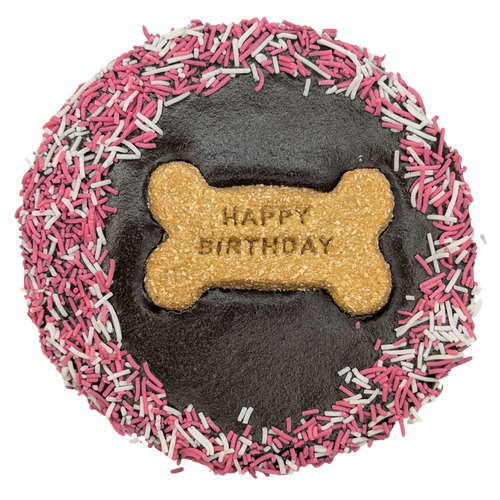
Carob is a completely different plant. It comes from the pod of the carob tree, it is naturally sweet, it contains no theobromine and no caffeine, and it looks and behaves enough like chocolate to give you that rich brown birthday cake look without any of the risk. That is why our Dog Birthday Cake Dog Treat - Carob - 1 pce exists.
If you would prefer something lighter, the Dog Birthday Cake Dog Treat - Yoghurt - 1 pce gives you a paler, brighter cake that photographs beautifully against a dark coated dog. There is no nutritional reason to choose one over the other. Pick the one that suits the photo you want and the dog you have.
One more thing while we are here. A human birthday cake is not a fallback option. Between the chocolate, the sugar, the butter, and the very real possibility of xylitol in icing or in a sugar free version, it is a genuinely bad idea. If you want your dog in the photo with a cake, use a cake made for dogs.
Matching cake size to dog size
The most common mistake we see is buying a cake sized for the occasion rather than for the dog. A birthday cake is a treat, not a meal, and a whole cake eaten in ninety seconds by a small dog will give you an unhappy evening.
Treats of any kind should only ever be a small part of a dog's daily intake, and a birthday is a good day to be relaxed about that, not a good day to abandon it entirely. Reduce their normal dinner a little on the day to make room, and if your dog has any health condition, is on a prescription diet, or has a sensitive stomach, check with your Australian vet before you introduce anything new.
| Dog size | Rough weight | Cake approach | Bone or biscuit to pair with it |
|---|---|---|---|
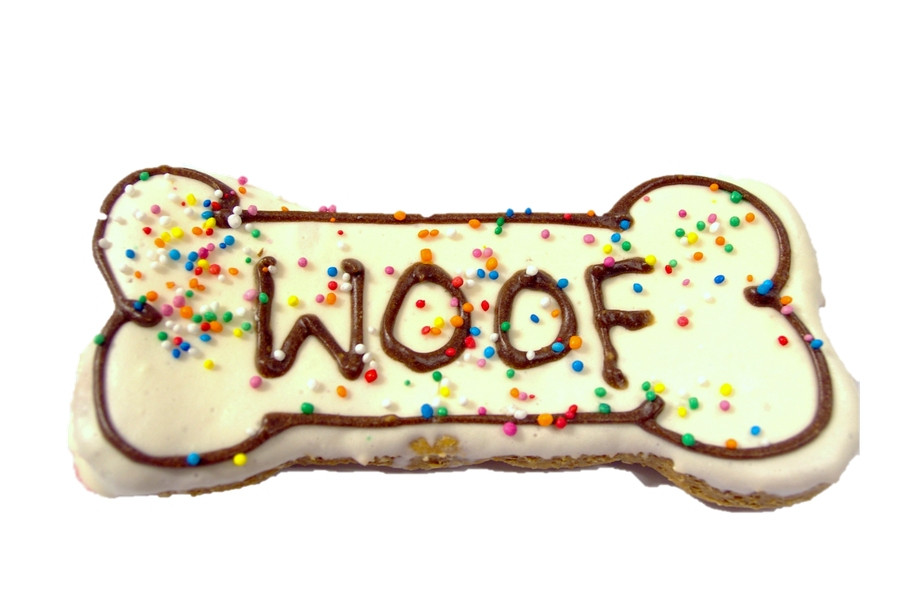
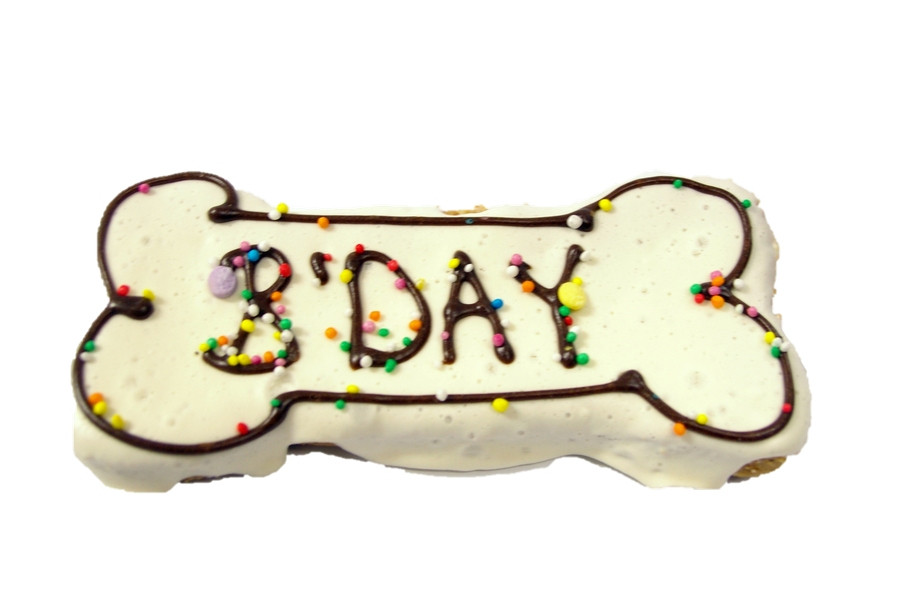
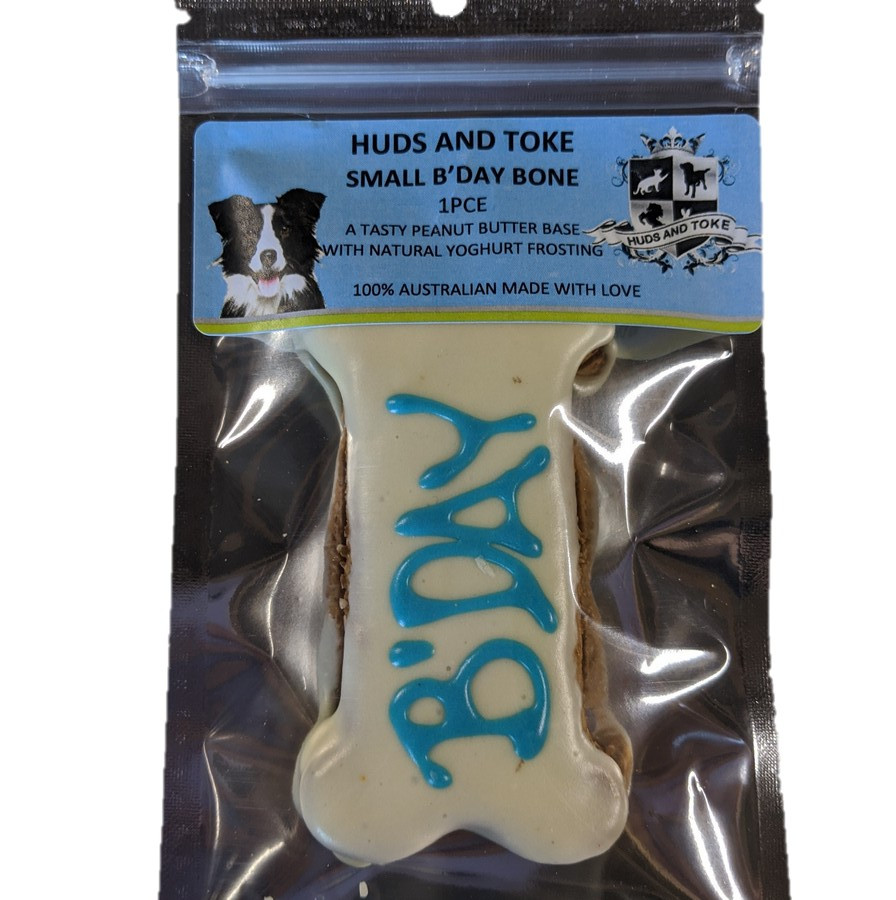
| Toy and small | Under 10 kg | One cake, cut into small portions and shared or spread across two or three days | Small Dog Bday Bone - Dog Treats or Small Woof Bone - Dog Treats |
| Medium | 10 to 25 kg | One cake, a decent slice on the day, the rest stored | Small Dog Bday Bone - Dog Treats for a smaller medium, or step up to the large bone |
| Large | 25 to 40 kg | One cake as the centrepiece, a generous slice on the day | Large Bday Bone - Dog Birthday Bone - Dog Treats or Large Woof Bone - Dog Treats |
| Giant | Over 40 kg | One cake is still a treat, not a meal. Resist the urge to scale up | Large Bday Bone - Dog Birthday Bone - Dog Treats |
| Multi dog party | Mixed | One cake for the photo, cut into small pieces for guests, plus separate biscuits | A gift box such as Pink Mixed Cookies - Dog Gift Box - Dog Treats or Blue Mixed Cookies - Dog Gift Box - Dog Treats |
Serving the cake without a scuffle
Food is the highest value thing at the party, which makes it the most likely trigger for conflict. Handle it deliberately.
- Take your photos with the whole cake first, before any dog has tasted it.
- Cut the cake indoors or well away from the dogs.
- Separate the dogs before serving. Different corners of the yard, behind a gate, on lead with their owner, or one at a time. Whatever suits your space.
- Each owner gives their own dog their own piece.
- Let each dog finish and settle before you bring the group back together.
- Sweep up every crumb before dogs are back in the area. Crumbs on the ground with six dogs looking for them is exactly how a scuffle starts.
Store any leftover cake in an airtight container. Follow the storage guidance on the packaging, and freeze portions if you have more than a few days worth. It also makes a very good next week treat when everyone has forgotten the party happened.

Party Food Do's and Don'ts: Two Menus, One Party
Run two entirely separate menus and keep them physically apart. Human food on the table, dog food on a different surface, and nothing crosses over.
The single most common cause of a dog getting sick at a party is not a deliberate decision. It is a guest slipping something under the table, or a dropped plate, or a bin bag left where a determined nose can reach it.
The genuinely dangerous list
These are the ones to be firm about. If your dog eats any of them, ring your Australian vet or an emergency vet immediately, and do not wait to see whether symptoms develop.
| Food | Safe for dogs? | Why |
|---|---|---|
| Chocolate of any kind | No | Contains theobromine and caffeine, which dogs cannot process properly. Dark and cooking chocolate are worst |
| Grapes, sultanas, raisins, currants | No | Linked to kidney failure in dogs. Watch for fruit cake, muesli bars, scrolls and hot cross buns |
| Onion, garlic, leek, chives, shallots | No | Damage red blood cells. Cooked, raw and powdered forms all count, including in gravy, dips and marinades |
| Xylitol (also labelled birch sugar) | No | Extremely dangerous even in tiny amounts. Found in sugar free lollies, gum, some peanut butters and some baked goods |
| Cooked bones of any kind | No | Splinter into sharp fragments. Cooked chicken, lamb and pork bones are a serious risk |
| Alcohol | No | Toxic to dogs. Watch unattended glasses at dog height, which is exactly where they usually are |
| Macadamias | No | Cause weakness and tremors in dogs. Very common in Australian baking |
| Avocado | Best avoided | The stone is a choking and blockage hazard, and the fat content upsets many dogs |
| Very fatty foods, sausages, cheese platters, fatty offcuts | Best avoided | Rich, fatty food can cause serious stomach upset and pancreatitis, particularly in one big hit |
| Corn cobs | No | A classic Australian barbecue hazard. Dogs swallow them whole and they cause intestinal blockage |
| Skewers and toothpicks | No | Meat smell plus a sharp stick. Bin these immediately in a secured bin |
| Purpose made dog treats and cakes | Yes, in sensible portions | Made for dogs, without the ingredients above. Still a treat, not a meal |
| Plain water | Yes, and lots of it | The most important thing on the table |
Bins deserve their own mention. A dog who gets into a party bin can access cooked bones, corn cobs, skewers, onion soaked scraps, foil and cling film all in one go. Use a bin with a lid, put it somewhere dogs cannot reach, and take it out to the wheelie bin before the guests leave rather than after.
The dog menu
Keep it simple and keep the quantities modest.
- The birthday cake as the centrepiece
- A themed bone for the birthday dog, sized correctly
- Small biscuits for the guest dogs, one or two each, handed out by their own owners
- Frozen broth cubes or ice treats in summer, which double as cooling
- Plain, dog safe fresh options if you want to bulk out the spread, such as carrot sticks or a few blueberries
Have a look at the wider dog treats range if you want variety, but resist the urge to give six new things in one afternoon. New treats plus excitement plus heat is a recipe for an upset stomach that evening. One or two new items is plenty.
Dressing Up: The Hat Makes the Photo
You do not strictly need a hat. But every single time we see a dog birthday photo that people have printed and framed, there is a hat in it.
The Dog Birthday Party Pom Pom - Hat and Bandana Set is our most popular option because the bandana does most of the work. If your dog genuinely will not tolerate a hat, the bandana alone still reads as party in a photo. The Dog Glitter Party Hats and Bowties set is the sparkly version and photographs particularly well in late afternoon light.
How to get a dog to actually wear a hat
Do not put it on for the first time on the day. Start about a week out.
- Day one. Show the hat, let the dog sniff it, give a treat. That is the entire session. Ten seconds.
- Day two. Hold the hat near their head, treat, remove. Repeat three or four times.
- Day three. Rest it on their head for one second, treat, remove before they shake it off.
- Day four. Two or three seconds, then a treat.
- Days five and six. Build to ten or fifteen seconds. Take a practice photo.
- Party day. The hat is already familiar and boring, which is exactly what you want.
The key is always removing the hat before the dog decides to remove it themselves. If they shake it off and then get a treat, you have taught them that shaking it off is the trick.
If your dog is clearly unhappy at any stage, stop. A bandana is a perfectly good substitute and no photo is worth a stressed dog.
Costume safety
- Never leave a dressed up dog unsupervised, even for a minute.
- Check nothing is tight around the throat. You should fit two fingers under any strap comfortably.
- Nothing should restrict vision, hearing, panting or movement.
- Remove hats and bandanas in the heat. Anything extra on a dog on a hot day is extra insulation.
- Watch for small parts. Pom poms, buttons, elastic and glitter trim are all chewable and swallowable. Take costumes off the moment the photos are done.
- Total time in costume for most dogs should be a few minutes, not the whole party.
Decorations, and the Balloon Question
Decorations make the photos, so they are worth doing. They also introduce most of the small hazards at a dog party, so they are worth doing carefully.
Let us deal with balloons directly, because we sell party balloons and we would rather you use them well than not at all.
A popped balloon is a choking and intestinal blockage hazard. Latex fragments are soft, they cling, and dogs swallow them without chewing. Some dogs are also genuinely frightened by the bang, and a dog who has a fright at their own party will remember the yard, not the cake.
So here is how to use balloons sensibly. Hang them high, above dog head height and out of reach of a tail or a jump. Use them as a photo backdrop rather than as something loose in the play area. Count them at setup and count them again at pack down. If one pops, stop everything and find every single piece before dogs come back into the area. And if your dog is noise sensitive, skip balloons entirely and use bunting, which does the same visual job without the bang.
The same thinking applies to everything else. Ribbon and string are swallowing hazards. Tinsel and glitter are worse. Candles are an open flame at exactly tail height, so if you want the candle photo, use a battery operated one. Cellophane and cling film smell like food and get eaten. Skewers and cocktail sticks go straight into a lidded bin.
If you want a low effort, low risk setup, the answer is bunting, a backdrop sheet or a picnic rug, a few potted plants, and good natural light. That is genuinely all a great dog birthday photo needs.
Party Games That Cost Nothing
You do not need to buy anything. The best dog party games use things you already own, and most of them work better than expensive alternatives because they involve sniffing, which tires dogs out far more effectively than running.
The muffin tin game
Put a small treat in some of the holes of a muffin tray, cover every hole with a tennis ball, and let the dog work out how to get them. Brilliant for one dog at a time, useless with a group, because it turns into competition. Run it as a one dog at a time activity while the others watch.
Find the treat
Have someone hold the dog while you hide treats around the yard in easy spots. Release, say "find it", and let them work. Start easy so they get the idea. This is the single best energy burner at a party and it works in any weather, including indoors on a hot day.
Pass the parcel, dog edition
Wrap a treat in a few layers of butcher's paper or an old towel and let the dog unwrap it. Supervise closely and take the paper away as they go, because dogs will happily eat paper. Best done one dog at a time.
Musical sits
Play music, everyone dances about with their dog, stop the music, and every owner asks their dog for a sit. Last one to sit is out. This is more of a game for the humans than the dogs, and it is very funny to watch.
The recall relay
Two people stand a distance apart and take turns calling the dog, rewarding every arrival. Excellent exercise, and it is genuinely useful training disguised as a game. With multiple dogs, run one pair at a time.
Bubbles
Dog safe bubbles, or plain unscented bubbles, produce reliably delightful chaos. Do not let dogs eat large quantities of bubble solution and avoid it entirely if your dog has a sensitive stomach.
The obstacle course
A broom across two buckets to step over. A cardboard box tunnel. A blanket to walk across. Cones or thongs to weave between. Run each dog through separately with their own owner and their own treats. Keep jumps very low, and skip jumping entirely for puppies, seniors and long backed breeds.
Games to avoid at a party
- Tug of war between two dogs who do not live together
- Fetch with multiple dogs and one ball. This is the classic party fight. If you play fetch, one dog at a time, or one ball per dog thrown in different directions
- Anything involving a high value chew or bone in a group setting
- Chasing games that get faster and faster with no breaks
- Anything where a dog cannot get away if they want to

Managing Kids and Dogs Together
Children and dogs at parties are a wonderful combination and also the situation where most bites happen. Both statements are true and the second one is not a reason to exclude kids. It is a reason to set the party up properly.
The core issue is that children do things dogs find confronting. They hug. They lean over. They put their face right up to a dog's face. They run and squeal. They approach dogs who are eating, sleeping or hiding. Every one of those is a behaviour a dog might reasonably object to, and children cannot read the warning signs that come before the objection.
Rules to state out loud at the start
- Pat dogs on the chest, shoulder or side. Not on top of the head, not on the face.
- Always ask the dog's owner first, every time, even for a dog you patted five minutes ago.
- Never hug a dog and never put your face near a dog's face.
- Leave a dog alone if they are eating, chewing, sleeping, or lying in the quiet space.
- If a dog walks away from you, let them go. That is the dog saying no.
- No running or squealing near the dogs.
- Nobody goes into the quiet space. Nobody.
Structural things that work better than rules
Rules are only as good as the supervision behind them, and at a party supervision slips. So build the safety into the layout instead.
Set up the kids' area and the dog area with physical separation, even if it is just a portable gate or a run of chairs. Give the children their own activity that has nothing to do with the dogs, so they are not simply waiting for a dog to become available. Assign one adult to the children and one adult to the dogs, and make sure those are two different people.
Have a designated dog free zone for any human guest who is nervous around dogs, and mean it. Somebody who is frightened of dogs having a good time is worth more than one extra dog in the yard.
And when the kids are getting overtired and loud, that is your signal that the dogs need a break too. The two things escalate together, every time.
Photography That Actually Works With Dogs
The photos are the thing you keep. Here is how to get good ones without spending an hour chasing your dog around the yard with a phone.
Timing
Shoot early, in the first twenty or thirty minutes, before the dog is hot, tired and covered in grass. Everyone waits until the cake moment and by then the dog has had enough. Do a proper photo session first, then relax and shoot casually for the rest of the day.
Light matters more than your camera. Early morning and late afternoon light is soft and warm. Harsh midday sun creates hard shadows across the dog's face and makes them squint. If you are stuck with midday, move into open shade, under a verandah or a tree, and shoot there.
Technique
- Get down to the dog's eye level. Kneel or lie down. This one change improves dog photos more than anything else.
- Use burst mode and take far more frames than you think you need. Dogs move constantly and you are playing a numbers game.
- Focus on the eyes. If the eyes are sharp, the photo works.
- Have a second person hold a treat or a squeaky toy just above your lens to get the head tilt and the ears up.
- Make a new, unusual noise right before you shoot. A kissy noise, a whistle, a squeak. It works once or twice per noise, then you need a new one, so bring several.
- Shoot against a plain background. A fence, a wall, a hedge, or a hung sheet. Busy backgrounds make good photos look messy.
- For black dogs, expose for the dog and shoot in shade to hold the detail in their coat. For white dogs, avoid bright sun which blows out the fur.
The shots worth planning for
- The formal portrait, hat on, cake in front, dog looking at camera
- The moment of first taste, which is usually the funniest photo of the day
- The action shot, mid run or mid jump, taken in burst mode
- The group photo of all the dogs, which will take twenty attempts and be worth it
- The owner and dog photo, because you are almost never in these and you should be
- The end of day shot of an exhausted dog asleep in a party hat that has slid sideways
The group photo, realistically
Put every dog on lead. Line the owners up behind or beside their dogs, out of frame or crouched low. Have one person stand behind the photographer holding a treat and making noise. Take thirty photos. Accept that in most of them, one dog will be looking the wrong way, and that this is what makes the photo funny in ten years. Two minutes maximum, then let everyone go.
Party Favours and Goodie Bags for Canine Guests
Goodie bags are a lovely touch and they solve a practical problem, because they let every guest dog take a treat home instead of eating everything in a crowded yard.
A good dog goodie bag has two or three items, not ten. Something to eat, something to play with, and something for the human.
- A biscuit or two, ideally something that suits a range of dog sizes. A gift box such as the Pink Mixed Cookies - Dog Gift Box - Dog Treats or the Blue Mixed Cookies - Dog Gift Box - Dog Treats can be split across several bags, or given whole as a gift to a close friend's dog
- A bone for the bigger guests, such as the Large Woof Bone - Dog Treats, or the Small Woof Bone - Dog Treats for the little ones
- A simple toy, or a roll of poo bags, which is genuinely the most appreciated item in any dog goodie bag
- A printed photo of the guest dog from the party, posted out afterwards. This costs almost nothing and people love it
Two practical notes. Hand the bags out as guests are leaving, not during the party, so nobody's dog gets into a bag full of treats in the middle of the yard. And write the dog's name on each bag along with a short ingredient list, so owners of dogs with allergies can check before they open anything.
Skip anything with small detachable parts, anything with ribbon that a dog could swallow, and rawhide, which we would not include in a goodie bag for a dog you do not know.
A Realistic Budget: Three Levels
Dog birthday budgets get out of hand for the same reason human ones do. Everything looks small individually. Set your number first and then work inside it.
All figures below are rough Australian estimates for planning purposes. Prices vary by supplier, by region and by season, so treat these as a shape rather than a quote.
| Item | Simple | Middle | Full production |
|---|---|---|---|
| Cake | One dog birthday cake | Cake plus a themed bone | Cake, bone and a biscuit gift box |
| Dressing up | Nothing, or a bandana you own | Hat and bandana set | Hat and bowtie set plus a bandana for each guest dog |
| Decorations | Bunting you already have | Bunting plus a few balloons hung high | Full backdrop, balloons, banner, props |
| Guest dog treats | None, human guests only | A handful of biscuits split between guests | Individual goodie bags per dog |
| Human catering | Tea and a packet of biscuits | Basic platter or a barbecue | Proper catering or a hired venue |
| Extras | Nothing | A clam shell pool and extra water bowls | Marquee hire, professional photographer, venue hire |
| Rough total | Under $50 | $100 to $200 | $400 and up |
| Guest count it suits | Family, one dog | A few friends, two to four dogs | A crowd, or a milestone birthday |
Our honest advice, from watching a lot of these, is that the middle column is the sweet spot. The jump from simple to middle buys you a noticeably better day. The jump from middle to full production mostly buys things the dog cannot perceive.
If you want to save money, spend it on the cake and the hat and skip everything else. Those two items carry the photo, and the photo is the part that lasts. If you want to save time as well as money, the dog birthday bundles put the main pieces together in one go, and the broader dog birthday range is where to browse if you are still deciding.
The Run Sheet: How the Day Actually Goes
This is a two hour party, which is the right length for almost every dog gathering. Adjust the clock to suit your start time, but keep the shape.
| Time | What happens | Why it is at this point |
|---|---|---|
| Two hours before | Walk the dog. Normal breakfast, slightly smaller | A dog who has already exercised arrives at the party calmer |
| One hour before | Set up water stations, shade, mats, quiet space. Yard safety check | Do the boring work while you are calm and nobody is watching |
| Thirty minutes before | Decorations up, cake out of reach, bins secured, phones charged | Nothing on the ground before dogs arrive |
| 0:00 to 0:15 | Staggered arrivals. On lead introductions on neutral ground, walk in together | Prevents the gate mob and the territorial flashpoint |
| 0:15 to 0:30 | Free milling about. No toys, no food. Off lead once everyone is settled | Let the group sort itself out before you add excitement |
| 0:30 to 0:45 | Photo session. Hats on, cake as a prop, group shot, then hats off | Everyone is clean, cool and still patient |
| 0:45 to 1:00 | Games, one dog at a time, with breaks between | Peak energy point, and structured activity beats unstructured chaos |
| 1:00 to 1:15 | Enforced quiet break. Every dog settles, water, shade, chew | This is the single most useful fifteen minutes of the party |
| 1:15 to 1:30 | Cake. Dogs separated, each owner serves their own dog, crumbs swept up | Energy is dropping, so food is less likely to cause conflict |
| 1:30 to 1:50 | Wind down. Casual photos, gentle sniffing games, humans eat | Ending on calm rather than on chaos |
| 1:50 to 2:00 | Goodie bags handed out at the gate. Guests leave one at a time | Staggered departures are as important as staggered arrivals |
| After | Full yard sweep, bins out, dog gets water and a quiet spot | Find every balloon fragment and dropped skewer before your dog does |
The two things people get wrong on this sheet are leaving photos too late and skipping the quiet break. Do both at the times shown and the rest looks after itself.
If a Scuffle Happens
Most dog parties have a moment. A snap, a growl, a brief noisy tangle that sounds far worse than it is. Knowing what to do in advance means you handle it in four seconds instead of forty.
Prevention, which is most of the answer
- Pick up all high value items before dogs arrive. Bones, chews, favourite toys, food bowls
- Multiple water stations, multiple shade areas, multiple exits from any space
- Interrupt play every couple of minutes
- Never let a group of dogs crowd around one item or one person
- Watch for the quiet stress signals and act on them early
- Give tired dogs a break before they need one
If it happens anyway
- Do not reach in with your hands and do not grab collars. This is how people get bitten, usually by their own dog, and usually by accident.
- Make a loud, sudden noise. A clap, a shout, an air horn if you have one. Most short scuffles break up on the noise alone.
- If noise does not work, use a barrier. A chair, a bin lid, a large piece of cardboard, a jumper thrown over the dogs' heads. Interrupt the line of sight.
- Water is effective if you have a hose or a bucket to hand.
- If dogs have to be physically separated, two adults each take one dog by the back legs or the hips and move backwards and apart, together, at the same time. Never one person alone, and never from the front end.
- Once separated, keep them separated. Different areas, out of sight of each other. Do not attempt to have them make friends again.
Afterwards
Check both dogs thoroughly. Puncture wounds are easy to miss under fur and can look like nothing while being significant underneath. Any puncture, any bleeding, any limping, or any dog who seems dazed, get to your Australian vet. Bite wounds carry a real infection risk even when they look minor.
Check the humans as well, because people get bitten breaking up fights more often than they admit.
Then end the party for those dogs. Not as a punishment, but because a dog who has just had a fight is flooded with adrenaline and will not make good decisions for a while. Send them home early and follow up with the owner the next day.
Do not spend the evening deciding whose dog was at fault. In almost every case the answer is that the environment was too much, and the environment is the thing you can fix next time.
Clean-Up and What to Do With Leftovers
The clean-up is a safety job, not just a tidying job, so do it before you sit down.
The safety sweep
- Walk the whole space in a grid and pick up every balloon fragment, ribbon, cable tie and piece of cellophane
- Collect every skewer, toothpick, corn cob and bone from the human menu and get them into a secured bin outside
- Check under tables and chairs, where the dropped food goes
- Collect all glasses, especially any with alcohol in them
- Pick up leftover cake crumbs, which will otherwise be found later by a dog with nothing better to do
- Take the bin bags out to the wheelie bin immediately rather than leaving them by the back door
- Check gates are shut and latched
Leftover dog cake and treats
Store leftover dog cake in an airtight container and follow the storage instructions on the packaging. Portion and freeze anything you will not use within a few days. Frozen slices are excellent in summer, straight from the freezer.
Resist the temptation to give the leftovers to your dog over the next two days just because they are there. A birthday is one indulgent day, not an indulgent week. Spread it out, reduce their normal meals slightly on the days you serve it, and keep an eye on their stomach for a day or two after any new treat.
The evening after
Expect your dog to be flat, and to sleep hard. That is normal. What is not normal is vomiting, diarrhoea, a distended or painful belly, unusual lethargy that continues into the next day, difficulty breathing, or any sign they may have swallowed something they should not have. Any of those, ring your Australian vet.
Give them water, a quiet dark spot, and no expectations for the rest of the evening. Do the same for yourself.
Celebrating a Gotcha Day Instead
A great many Australian dogs are rescues, and a great many rescue owners have no idea when their dog was born. The vet said roughly two years old, and that was that.
Gotcha Day, the anniversary of the day you brought them home, is a better celebration anyway. It marks something that actually happened, that you were both there for, and that changed both your lives. Plenty of people with a known birthday celebrate the Gotcha Day instead, and we think they are onto something.
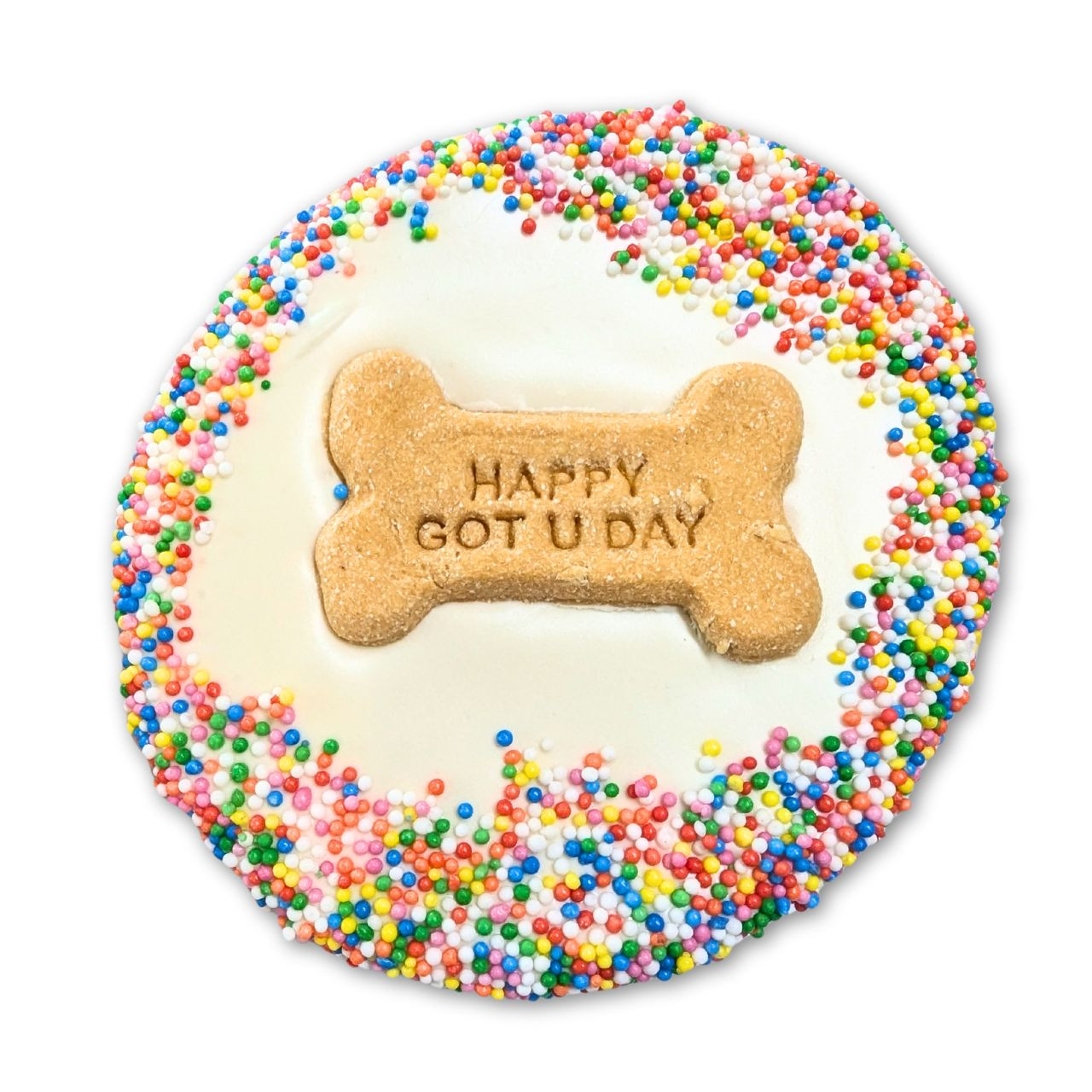
Everything in this guide applies exactly the same. The only thing that changes is the wording on the cake. We make the Happy Got U Day Dog Cakes - Yoghurt Dog Treat - 1pce and the Large Gotcha Bone - Got U Day - Dog Treats specifically for this, because we got tired of hearing from customers who felt a bit odd buying a birthday cake for a day that was not a birthday.
Gotcha Day traditions worth starting
- Retrace the drive home from the shelter or the airport, if it is close enough
- Take one photo in the same spot every year and watch the dog age across the frames. This is the tradition people treasure most
- Do their favourite walk, the whole thing, at their pace, with as much sniffing as they want
- Make a small donation to the rescue or shelter they came from, or drop off a bag of food or a blanket
- Write down one thing about them from this year that you want to remember. Ten years of these is a remarkable thing to have
Gotcha Days often suit rescue dogs better than a big party does, because a lot of rescue dogs are still building confidence and a yard full of strangers is not their idea of a good time. A quiet Gotcha Day with the family, a cake, and a long walk is a genuinely complete celebration.
Quiet Alternatives for Anxious and Senior Dogs
If you got to this section because you recognised your dog earlier, this is the good bit.
An anxious dog, a reactive dog, or a fourteen year old with sore hips does not want a party. They want a really excellent version of an ordinary day. That is easy to give them and it costs almost nothing.
The perfect quiet birthday
- A sniffari walk. Their normal walk, but you go at their pace and let them sniff everything they want for as long as they want. No agenda, no distance goal. Sniffing is mentally satisfying and physically gentle, which makes it perfect for both anxious and senior dogs.
- A new place, chosen carefully. A quiet beach at low tide, a bush track on a weekday morning, a river bank. New smells without new dogs.
- A car trip with the window down, if your dog is one of the many who considers this the finest thing in life.
- Their cake, at home, with just their people. A slice of a Dog Birthday Cake Dog Treat - Yoghurt - 1 pce on the back step with nobody watching but you.
- A long, undisturbed nap in the sunniest spot in the house, with nobody moving them.
- Twenty minutes of undivided attention. No phone. Just brushing, or a slow massage, or sitting with them.
Adjusting for a senior dog
- Shorter and gentler beats longer and more exciting. Two short walks are better than one long one
- Watch the ground. Slippery floors, steps and jumping in and out of the car are the things that hurt older dogs
- Keep treats soft if their teeth are not what they were. Break biscuits into smaller pieces or soften them slightly
- Stick to their routine. Older dogs find changes to the schedule more unsettling than younger ones
- Keep them warm in winter and cool in summer. Seniors regulate temperature less well
- If they are on medication or a prescription diet, check with your Australian vet before giving anything new, even a small piece of cake
Adjusting for an anxious dog
- No visitors, or one visitor the dog already loves
- No costumes. A bandana at most, and only if they already wear one happily
- No balloons and nothing that pops or bangs
- Go somewhere quiet at a quiet time of day rather than somewhere new and busy
- Let them opt out of everything. If they want to be under the bed, that is their choice and it is fine
- Take the photo at home, in their own bed, where they are already relaxed. These end up being the best photos anyway
There is no rule that says a celebration has to look like a party. Nobody is marking you on it. A dog who spent their birthday sniffing a creek bank for forty minutes and then eating a slice of carob cake on the back step has had a better day than a nervous dog surrounded by strangers in party hats, and both of you will enjoy it more.
The Thing Worth Remembering
Every year we get photos sent to us. Cakes with a bite taken out of them, hats sliding sideways, dogs mid sneeze, three dogs in a group shot with two of them looking at something off camera. Almost none of them are technically good photographs and every single one of them is brilliant.
What comes through in all of them is not the decorations or the budget. It is that somebody thought a dog was worth making a fuss over.
So plan it properly. Watch the heat, spread the water bowls around, keep the dog numbers sensible, take the photos early, set up the quiet space and actually use it, keep the human food and the dog food apart, and finish before everyone is worn out.
Then put the phone down for the last twenty minutes and just watch your dog have a good afternoon. That is the whole point of it.
Everything for the day is baked in our own kitchen on the Sunshine Coast, from the cake down to the party hats.
Shop the dog birthday rangeDog Birthday Party FAQs
Quick answers to the questions Australian dog owners ask most about throwing a party. This is general guidance only, and your own vet always has the final word for your dog.
What kind of cake can dogs eat for their birthday?
A cake formulated for dogs, not a human cake. Look for one decorated with carob and a dog-safe yoghurt frosting rather than chocolate and sugary icing. Carob looks like chocolate but is free from theobromine and caffeine, so dogs get the full party look without the risk. Our cakes are hand-decorated in our Australian bakery using exactly that combination.
Why is chocolate dangerous for dogs?
Chocolate contains theobromine, which the RSPCA confirms is toxic to dogs. The risk depends on your dog's size, the amount eaten and the type of chocolate, with cocoa powder, baking chocolate and dark chocolate the most dangerous. If your dog eats chocolate, even a small amount, contact your local vet as soon as possible.
How far in advance should I order a dog birthday cake?
One to two weeks ahead is the comfortable window. Hand-decorated dog cakes are made to order and shipped Australia-wide, so ordering when you set the party date means the cake is never the thing holding up the celebration.
How many dogs should I invite to a dog birthday party?
Two to four dogs your dog already knows and likes is the sweet spot. Small guest lists keep play relaxed and supervision easy. Introduce any unfamiliar dogs on lead on neutral ground first, keep an eye on body language, and give any overwhelmed guest a quiet space away from the action.
What should I put in party bags for the dog guests?
A few individually packaged dog-safe treats or a small dog gift box works perfectly, the canine version of the lolly bag. Hand them to the humans on the way out and let each owner decide when their dog gets them, since every dog's diet and tummy is different.
Do dogs actually know it is their birthday?
Honestly, your dog cannot read a calendar. What they absolutely do notice is a yard full of favourite people, new smells, games, and a cake with their name on it. The date is for you, the party is for them, and that is a perfectly fair split.
Huds and Toke: Proudly Australian, Family Owned
We have been baking and drying pet treats in our own HACCP-certified kitchen on Queensland's Sunshine Coast since 2012. Everything is made here, using Australian ingredients, with no added sugar and no artificial colours or preservatives.
Cite this article: The Huds and Toke Editorial Team (2026). How to Throw a Dog Birthday Party in Australia: The Complete Guide Huds and Toke, published 22 July 2026. https://hudsandtoke.com.au/dog-birthday-party-guide-australia/
References
- RSPCA Australia Knowledgebase. What should I feed my dog? https://kb.rspca.org.au/knowledge-base/what-should-i-feed-my-dog/
- RSPCA Australia Knowledgebase. What should I know before feeding dog treats? https://kb.rspca.org.au/knowledge-base/what-should-i-know-before-feeding-dog-treats/
- RSPCA Australia Knowledgebase. What are common household dangers for pets? https://kb.rspca.org.au/categories/companion-animals/household-and-garden-dangers/what-are-common-household-dangers-for-pets
- Animal Medicines Australia. Pets in Australia survey (media release). https://animalmedicinesaustralia.org.au/news-and-media/australias-most-comprehensive-pet-survey-shows-nearly-three-quarters-of-australian-homes-now-have-a-pet/
- Greencross Vets. Caring for a Senior Dog. https://www.greencrossvets.com.au/pet-health/life-stages/dogs/senior/