Safe Chews for Dogs: 14 Natural Chews Ranked for Your Dog's Teeth (Australian Guide)
Posted by The Huds and Toke Editorial Team on 7th Sep 2026
Your dog's back teeth can out-muscle almost anything you hand them, and their enamel is thinner than yours. Here is the thumbnail test veterinary dentists use, the one tooth that breaks first, and 14 natural chews ranked on fracture risk, digestibility, choking risk, fat and typical chew time.
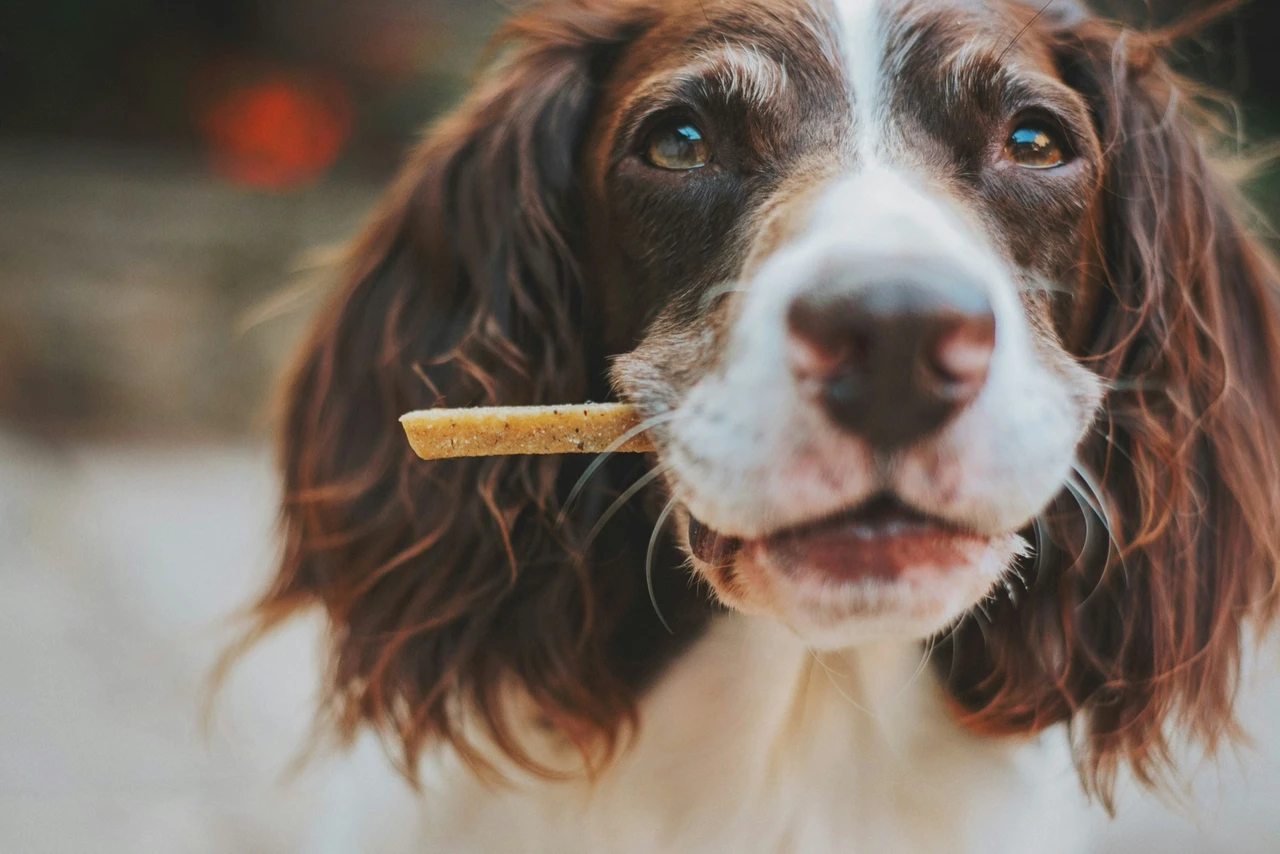
Dogs bite hard, and their enamel is thin. That is the reason Australian vets keep taking cracked teeth out of otherwise healthy dogs: the chew was harder than the tooth.
Worth saying upfront. We make dog treats for a living, on Queensland's Sunshine Coast, since 2014, and we make most of the chews on this list. No single chew suits every dog, so rather than pretend otherwise we have sorted the whole range by hardness and matched each one to the chewing style it is built for, using the same veterinary yardstick for all of them.
The headline findings, in 30 seconds
- Dental disease is the norm. RSPCA Australia reports 70% of cats and 80% of dogs experiencing some level of dental disease by three years of age.
- The test is your thumbnail. Cornell (overseas) reports that most veterinary dentists suggest that you should be able to make a dent in the item with your fingernail.
- One tooth breaks most. Sydney Pet Dentistry reports slab fractures of the upper carnassials among the most common problems it sees.
- The forces are lopsided. Dog bite force has been measured as high as 3,417 Newtons at the molars (overseas); tested upper fourth premolars fractured at a mean 1,281 N.
- Hooves, antlers and bones are the usual suspects. The Australian Veterinary Association names cow hooves and deer antlers among long-lasting chews behind broken teeth. Hooves are the hardest chew in our range, which is why we point them at calm nibblers, never power chewers.
- Supervise, and stay under 10%. The WSAVA (overseas) asks owners to supervise your dog with chews, treats and toys and keep treats under 10% of daily calories.
What's in this guide
- The short answer
- The thumbnail test
- How we rated each chew
- Which chewer do you own?
- Tendon chews
- Ear chews
- Snouts, tracheas and cartilage
- Organ and jerky treats
- Are cow hooves safe for dogs?
- Hard chews to avoid
- The size rule
- Best treats for teeth
- Do chews replace dental chews?
- Puppies, seniors and small dogs
- The chew chart: all 14
- Frequently asked questions
The short answer: which dog chews are safe for teeth?
The safest chews give way before a tooth does. Dried tendons, ears, snouts, trachea and cartilage all bend, dent or shred under pressure. The riskiest refuse to yield at all: cow hooves, deer antlers, bones and hard nylon. If your thumbnail cannot mark it, it is too hard for your dog.
That one rule sorts almost every chew on the shelf, and it is not ours. Vet Voice, from the Australian Veterinary Association, names rawhide, tough jerky-style treats, pig's ears, deer antlers and cow hooves as long-lasting chews. VCA (overseas) turns the test into a specification: any chew toy or dental treat fed to a dog should bend and give upon compression.
The second rule is size, because a chew that is kind to teeth can still be swallowed whole. We cover both risks for every chew below.
How hard is too hard? The thumbnail test explained
Press your thumbnail hard into the chew. A visible dent, or any flex, means it is generally kind to teeth. If your nail slides off and leaves nothing behind, your dog's tooth is the softer of the two objects in that contest, and it will not be the hoof that gives.
Cornell's Riney Canine Health Center (overseas) reports that most veterinary dentists go by the thumbnail test: they suggest that you should be able to make a dent in the item with your fingernail. VCA (overseas) gives the discard version: throw out chews or toys that do not readily bend. Dr Fraser Hale (overseas) has a blunter one.
"If your dog would not want me to hit them on the knee cap with it, they should not be allowed to chew on it!"
Dr Fraser Hale, DVM FAVD DipAVDC, Vet Dent Edu, Canada (overseas). Source.
Why does something this crude work? Because the margin is thin. Bite forces in dogs have been found to be as high as 3,417 Newtons at the molars (Dr John Lewis, overseas), and the enamel taking that load is thin: measured across 194 teeth, canine and feline enamel varied in thickness from 0.1 mm to 1 mm, against up to 2.5 mm in human teeth.
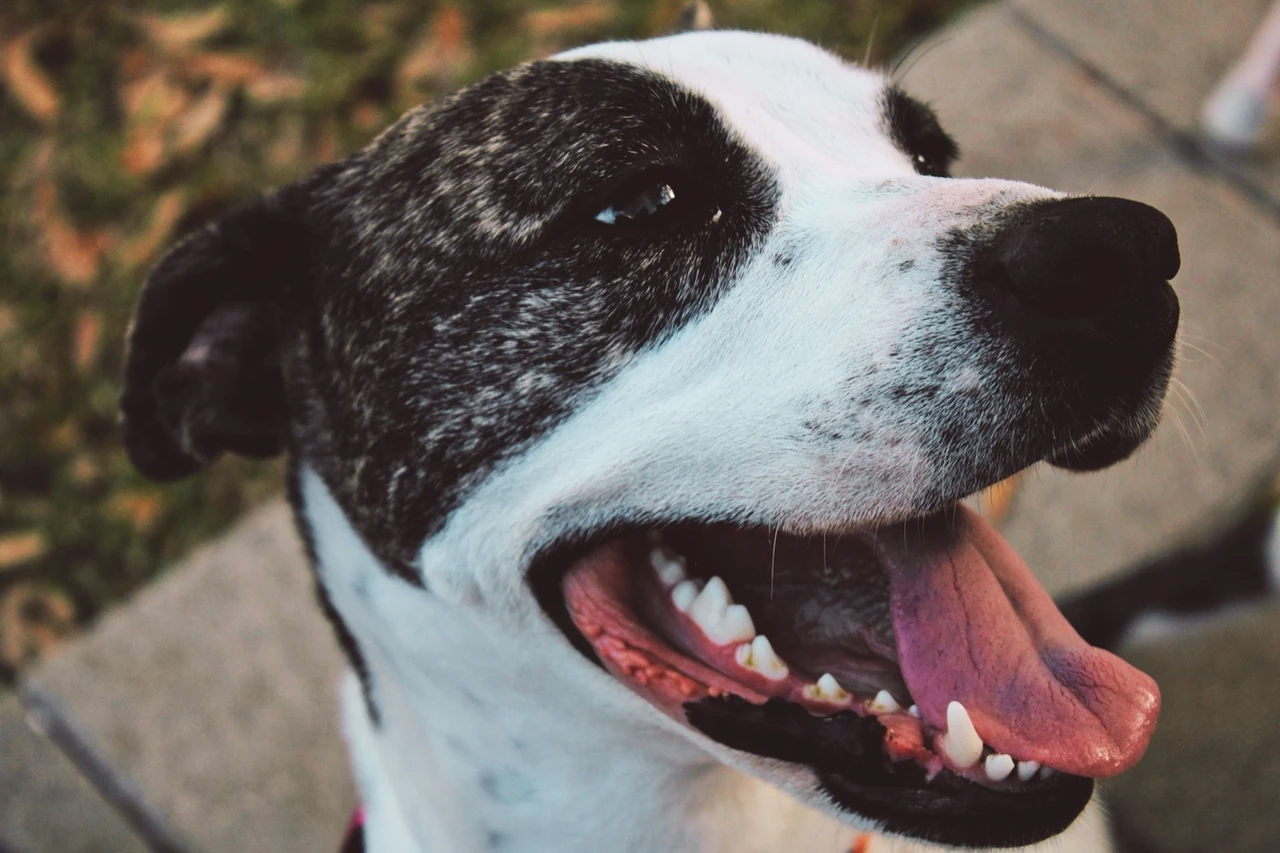
Why the upper fourth premolar breaks first
The big premolar at the back of the upper jaw is the carnassial, the shearing tooth. It does the heavy work and it pays for it. Sydney Pet Dentistry explains the mechanism in one sentence.
"Dogs chew in a scissor-like action and if the tooth is strong, the object being chewed will break in the action of the scissors."
Sydney Pet Dentistry, veterinary dental specialist practice, Sydney. Source.
When the object refuses to break, the scissors do. The whole side of the tooth snaps off, and the practice names chewing bones as the most common cause of this injury. Once a crack passes dentine into the dental pulp, the University of Sydney Veterinary Teaching Hospital says the tooth can become infected and painful, leading to endodontic disease and tooth death: extraction or root canal.
The cruel part is how quiet it is. Dr Jan Bellows (overseas) notes that for many dogs, broken teeth do not show signs of discomfort even though they experience pain like humans. Watch for chewing on one side, dropping food, refusing hard treats, then book your Australian vet.
How to do the thumbnail test at home
4-step screen
Is this chew safe for my dog's teeth?
1. Press your thumbnail into the thickest part. Does it leave a dent?
2. Hold both ends and flex it. Does it give at all before it snaps?
3. Tap it against your own kneecap. Would you take a solid whack from it?
4. Hold it beside your dog's mouth. Is it clearly too big to swallow whole?
Verdict: Four yes answers and the chew is worth trying, supervised. A single no on questions 1 to 3 puts it in the bin, not the dog's mouth.
How we rated each chew
Every chew below is scored on five things: tooth-fracture risk, digestibility, choking and blockage risk, fat level and typical chew time. Hardness runs 1 (soft) to 5 (rock hard). These are Huds and Toke editorial ratings from handling our own product daily, not laboratory measurements.
Two honesty notes. Chew times are typical ranges for a medium dog, not measured data. And digestibility numbers exist for only a few broad categories, none of them Australian ear or snout chews: in vitro work (overseas) found bone was the least digestible treat category in both gastric and intestinal phases, while treats from meat products, dental, chew, biscuit, and cat treat categories had a high dry matter disappearance (over 85%). So we describe it qualitatively.
Supervision is part of every rating. No chew here is safe to leave with an unattended dog. The WSAVA (overseas) is blunt: supervise your dog with chews, treats and toys.
Which chewer do you own?
Four styles cover most dogs. Nibblers work slowly with the front teeth. Shredders tear things into strips. Gulpers swallow chunks the moment they come loose. Power chewers clamp down with the back teeth and try to break the thing outright. Style matters far more than breed.
Chewing itself is not the problem. RSPCA Australia is clear that chewing is a normal dog behaviour, and dogs should be provided with opportunities to chew things, and a 2025 review with University of Sydney authors (published overseas) found chewing appears to promote biological fitness, including dental and oral hygiene.
- The nibbler. Slow front-teeth work. The only dog we would hand a frosted hoof to.
- The shredder. Tears and separates. Loves ears, snouts and trachea.
- The gulper. The riskiest style. Slowly digestible treats should be discouraged for dogs that tend to consume large pieces of food without much mastication prior to swallowing (overseas).
- The power chewer. Serious back-tooth force. Needs long-lasting but yielding chews such as dried tendon.
Tendon chews
Tendon is our pick of the long-lasting chews. It is almost pure collagen, so it dries tough and fibrous rather than brittle. A power chewer can work one for a long stretch without meeting a surface hard enough to slab-fracture a carnassial, which is exactly what hooves and antlers cannot offer.
From our kitchen: the tendon chews


Are beef tendons good for dogs?
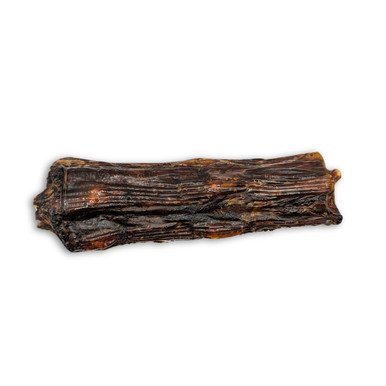
Yes, for most dogs, and it is the chew we suggest most often for determined chewers. Press hard and you will mark a dried beef tendon, and it flexes rather than shattering: 3 out of 5, typical chew time 15 to 45 minutes, lean rather than rich, which matters if your dog has a history of pancreatitis. We will not print a fat percentage, because we have not found a published one.
The watch-out is the last inch. Once a tendon is chewed to a swallowable stub it should come away, in line with the advice to remove any toy that has reached the size where it can become a choking hazard or cause an intestinal obstruction (Texas A&M, overseas).
Beef tendons for dogs in Australia (sourcing, sizing and drying)
Here is where being the manufacturer is useful. Drying decides whether a tendon stays flexible or turns into a glassy stick. Too fast and the collagen sets rigid; slowly, and it keeps a fibrous, leathery bend, which is what you want under a molar. For a small dog one beef tendon piece is plenty; for big dogs the 1kg pack lets you match piece to mouth.
Handling is the unglamorous part. Victoria's Better Health Channel notes the salmonellosis risk is greater for dried or raw pet foods, so treat a dried chew like raw meat on the bench. PFIAA members also make food that conforms to the Australian Standard for pet food, AS5812.
Kitchen tip
Give the chew a mat. One washable mat, used every time, keeps dried treats off the carpet and gives you a single surface to wipe down. The US FDA (overseas) recommends washing your hands for at least 20 seconds with soap and hot water afterwards.
Are kangaroo tendons good for dogs?
They are, and they suit smaller mouths better than beef. Kangaroo tendons are thinner and finer, so we rate them 3 out of 5 with a typical chew time of 10 to 30 minutes. They pass the thumbnail test and shred rather than splinter.
Kangaroo is the lean protein of the Australian pantry. The Department of Agriculture, Fisheries and Forestry states that kangaroo meat is high in energy, protein, iron, zinc, omega 3 fatty acids and B vitamins, and contains less than 2% fat. That is the meat, not a dried tendon. The 2024 figures put total harvest at 26.8% of the sustainable quota. More in our kangaroo dog treats range.
Kangaroo tails for dogs
Kangaroo tail pieces are the long-chew option in our range for experienced, supervised adult dogs: 4 out of 5, 30 to 60 minutes, with a bone component that puts them in a different bracket from tendons. RSPCA Australia's position is that bones and raw meat are not recommended as they can break teeth and cause internal blockages. A kangaroo tail piece is supervised, sized up and taken away early; gulpers skip it. Read our kangaroo tails verdict first.
Dried beef tendon
Dents under a thumbnail and flexes before it breaks. Lasts a long time because it shreds slowly, not because it is hard. Lean, single protein, breaks down as the dog works it.
Dried cow hoof
Lasts even longer, for the wrong reason: it does not yield. Named by the AVA among long-lasting chews linked to broken teeth. That is why we keep ours for calm, supervised nibblers rather than dogs that bite down hard.
Ear chews
Ears are the middle ground: soft enough to pass the thumbnail test easily, interesting enough to hold a shredder's attention, and short enough that they will not occupy a power chewer for long. The variable that separates them is not hardness. It is fat.
From our kitchen: the ear chews
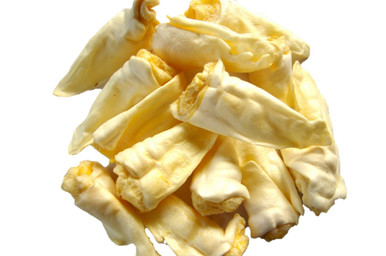

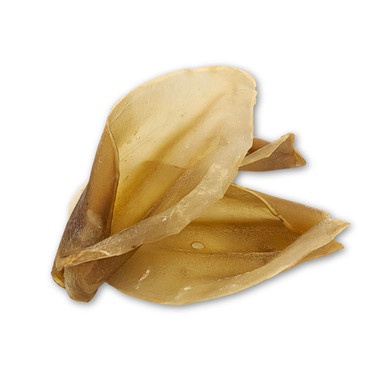
Are sheep ears good for dogs?
Sheep ears (lamb ears) are one of the gentlest real chews available: 2 out of 5, 5 to 15 minutes, and they dent under a thumbnail with no effort, which suits older and smaller dogs. Fat is moderate, so they count against the daily budget. RSPCA Australia notes dogs are less likely to get bored with activities that involve chewing or feeding. Ours: sheep ears.
Are pig ears safe for dogs?
Safe for teeth, yes. Rich, also yes: 2 out of 5, 10 to 20 minutes, and the fattiest of the ear chews, which matters for dogs with a pancreatitis history. VCA (overseas) notes pancreatitis may be triggered in some cases by a fatty meal.
Hygiene is the other consideration, and it is not hypothetical. A 2019 US FDA investigation (overseas) linked contaminated imported pig ear treats to 154 cases of human infection across 34 states. Those treats came from Argentina, Brazil and Colombia, not Australia, but the handling lesson travels. See are pig ears good for dogs and the product page.
Are beef ears good for dogs?
Beef ears are the leaner cousin: same softness, same 2 out of 5, 10 to 20 minutes, and less fat than a pig ear, which makes them our default for a dog watching its waistline. Once one is down to a swallowable flap, take it. See Australian beef ears and our beef dog treats.
Snouts, tracheas and cartilage
This group is the sweet spot for dogs who like texture without force. Snouts, trachea rings and cartilage are all cartilage-rich, so they crunch and give rather than resist. None will occupy a power chewer for an hour, and none are likely to cost you a carnassial.
From our kitchen: snouts, trachea and cartilage
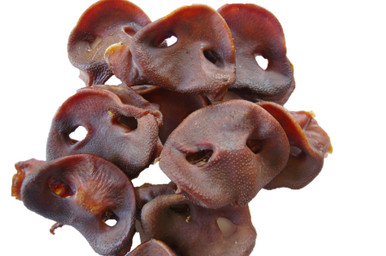
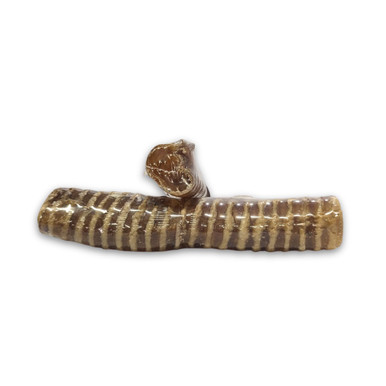
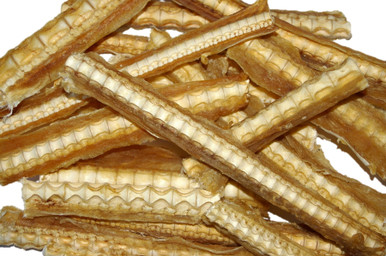
Are pig snouts good for dogs?
Yes, and they are underrated. A dried pig snout is cartilage and skin, so it crunches loudly and breaks down as the dog works it: 2 out of 5, 5 to 15 minutes, moderate fat. RSPCA Australia points out that enrichment has been shown to have wide-ranging benefits for dogs including promoting relaxation, reducing stress and anxiety. For a gulper, pick one too wide to go down whole.
Is beef trachea good for dogs? (Moo Tubes)
Beef trachea is a hollow cartilage ring and one of the easiest chews on teeth here, because it crushes flat rather than resisting, which is what VCA (overseas) asks for when it says a chew should bend and give upon compression. We rate Moo Tubes 2.5 out of 5, 5 to 15 minutes, moderate fat.
Trachea is often sold with glucosamine claims attached. We make none, because there is no feeding trial we can point you to.
Shark cartilage and shark tails
We make a dried shark cartilage chew and shark tails, and they behave like other cartilage: lean, crunchy, 2.5 out of 5, 5 to 15 minutes. A laboratory analysis found the content of chondroitin sulfate in shark cartilage was 29.97% (overseas), but that is a chemistry extraction figure, not a dose in a dog. On sourcing, the Australian Fisheries Management Authority states the Commonwealth catch of gummy shark is managed by quota and not overfished, that gummy sharks are the only targeted sharks in Commonwealth fisheries, and that it bans shark finning. Skipping shark products is still a reasonable call.
Organ and jerky treats for teeth
Organ and jerky treats are rewards, not chews. They are gone in seconds, they do almost nothing mechanically for teeth, and they are the easiest way to blow a dog's calorie budget without noticing. Use them for training, and keep the dental expectations for the longer chews above.
From our kitchen: the heart treats


Are chicken hearts good for dogs?
A good treat and a poor chew, and the difference matters. Heart is muscle meat rather than offal in the liver sense. We rate dried chicken hearts 1 out of 5, chew time measured in seconds. You will see taurine figures quoted for heart treats everywhere; we are not printing one, because the USDA entry for raw chicken heart lists no taurine value. It does list, per 100g raw, 153 kcal, 15.55g protein and 9.33g total fat (overseas, raw).
Are goat hearts good for dogs? (and kangaroo heart)
Goat heart and kangaroo heart fillet sit in the same bracket: single-protein muscle meat, dried, gone quickly, both 1 out of 5. Their value is as a novel protein and as high-value training currency. Neither is a dental item, so pair them with a tendon or an ear.
Are jerky treats good for dogs' teeth?
Barely. Jerky is thin, dry and quickly eaten, so there is little sustained abrasion: 1.5 out of 5, a few minutes, lean, across beef jerky and kangaroo jerky. The AVA's long-lasting list includes tough jerky-style treats, warning large treats can get stuck in the oesophagus, where they rehydrate and swell. Small pieces avoid that. More in our dog training treats guide.
Daily calorie budget
In plain English: The Pet Food Industry Association of Australia says a treat should comprise no more than 10% of your pet's daily energy requirement, and the WSAVA (overseas) agrees that treats should always make up less than 10% of a dog's daily calorie intake. For scale, the WSAVA energy table lists a 56g dried pig's ear at 242 calories. On a 400 kcal daily allowance the treat budget is 40 kcal, so one ear is six days of treats, or about 60% of the dog's entire day.
242 kcal
The energy in a single 56g dried pig's ear, per the WSAVA Global Nutrition Committee treat guide (overseas). Source.
Are cow hooves safe for dogs?
For the right dog, yes. A dried cow hoof is the hardest chew we make: it will not dent under a thumbnail and it will not flex, which is exactly what a slow, calm nibbler wants and exactly what a power chewer should not be given. It sits at 5 out of 5 on our hardness scale, so it is a nibbler's chew: adult dogs, supervised, and never for a dog that bites down hard.
From our kitchen: the hooves, for calm nibblers
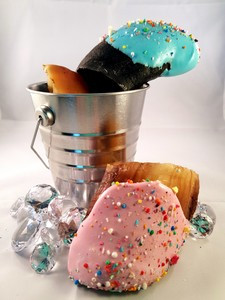
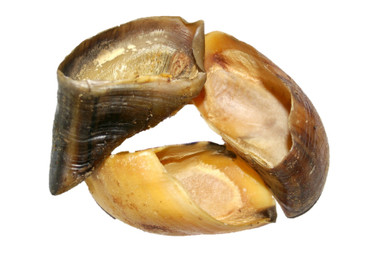
Vet Voice lists cow hooves among the long-lasting chews behind broken teeth, adding that broken teeth are painful and can sometimes lead to the development of abscesses, requiring tooth extraction and surgical treatment. VCA (overseas) is blunter: eliminate any bones, antlers, cow hoofs, nylon chews, and pizzle sticks. The WSAVA (overseas) says excessively hard chews and treats, for example, antlers and hooves, and those with sharp edges should be avoided. A hoof also chips rather than shreds.
That guidance is about dogs that bite down on a hoof, and a hoof is not one thing to every dog. A calm nibbler gnawing at the rim for an hour is doing something completely different from a power chewer trying to crack it in two, and the nibbler is the dog we make hooves for: supervised, adult, taking its time. The frosted Twinkle Toes hoof is a lick-and-nibble item, and the plain 1kg hooves carry the same caveat. If your dog breaks things, choose a tendon.
Who a hoof is for. Five out of five for hardness, so: adult dogs, calm nibblers and lickers, always supervised. If your dog bites down hard on everything, skip the hoof and choose a tendon. Same range, better match.
Hard chews to avoid: antlers, bones and nylon
Four items come up again and again in Australian and overseas veterinary advice: bones, deer antlers, hard nylon chews and ice cubes. They share one property. None of them yield. Everything else about them, including the fact your last dog was fine, is beside the point.
Why the RSPCA does not recommend bones
RSPCA Australia is unambiguous: bones and raw meat are not recommended as they can break teeth and cause internal blockages, raw bones also carry bacteria that can make both animals and humans ill. VCA (overseas) explains the mechanism: bones are very hard and can be brittle, making it easy for a dog to break one of its large chewing teeth, and fragments can cause a complete intestinal blockage.
If you feed bones anyway, Greencross Vets set limits: do not feed cooked bones as these tend to splinter and cause internal damage, the bone should be bigger than the dog's head, remove it before the bone itself is chewed up, and avoid cut marrow bones because the marrow is very high in fat, often associated with pancreatitis. Always supervise, and ask your Australian vet first.
"Vets frequently see pets with broken teeth as a result of chewing on these harder treats."
Australian Veterinary Association, Vet Voice, "The risks of long-lasting chew treats". Source.
Deer antlers
Antlers are the hardest thing most owners will ever hand a dog voluntarily. The University of Sydney Veterinary Teaching Hospital notes dogs can suffer from tooth fractures from chewing on hard objects such as deer antlers and bones. Texas A&M (overseas) says that when they became fashionable, veterinarians and veterinary dentists noticed an uptick in the number of fractured teeth they were seeing. The AAHA 2019 guidelines (overseas) state there is not a strong rationale for offering hard treats (antlers, synthetic, or natural bones) that could damage the structural integrity of the tooth. Five out of five on the hardness scale, and we do not make them.
Nylon, plastic and ice
No-go list
Four things that belong nowhere near your dog's molars
Hard nylon chews
VCA (overseas) lists them among the objects behind most tooth fractures.
Ice cubes
Cornell (overseas): do not let your dog chomp on ice cubes, though licking is okay.
Cooked bones
On RSPCA Australia's foods-to-avoid list. Greencross Vets warn they splinter.
Sticks from the yard
Greencross Vets advise avoiding hard bones or sticks, which can easily damage developing teeth.
Ice deserves its own sentence, because it looks harmless. Cornell (overseas) advises that you not let your dog chomp on ice cubes (but licking, chasing and playing with them is okay), and VCA (overseas) puts ice at the front of its list of objects behind most tooth fractures.
The size rule and when to take a chew away
A chew should be too big to swallow whole when you hand it over, and it should leave your dog's mouth before it shrinks to a swallowable size. Every chew has a moment where it stops being a chew and becomes an object. Your job is to notice that moment first.
RSPCA Australia applies this to bones for puppies, which should be large enough so that the puppy cannot fit the whole bone in their mouth or swallow the bone whole. The WSAVA (overseas) generalises it: ensure that any treat offered is an appropriate size and shape to reduce the risk of choking.
Two swallowing risks are worth separating. The AVA warns large treats can get stuck in the oesophagus, where they rehydrate and swell, requiring anaesthesia for retrieval. Further down, Cornell (overseas) lists the signs of obstruction as vomiting, loss of appetite, abdominal pain, diarrhoea, dehydration and lethargy.
At home it is a routine, not a rule you memorise. Sit within arm's reach, trade the stub for something better rather than snatching it, and follow the Veterinary Oral Health Council's framing: limit giving the treats to times when the owner is available to observe the dog chewing the treat (overseas).
Which dog treats are best for teeth?
Match the chew to the dog's size and style, not its breed. A 6kg dog and a 40kg dog can both have a tendon, they just need different pieces of it. The best chews for teeth are the ones a dog will work at for a while without ever meeting a surface hard enough to fracture a tooth.
| Your dog | Start here | Step up to | Skip |
|---|---|---|---|
| Small, under 10kg | Sheep ears, pig snouts | Kangaroo tendons | Hooves, antlers, bones |
| Medium, 10 to 25kg | Beef ears, Moo Tubes | Beef tendons | Hooves, antlers, bones |
| Large, over 25kg | Beef ears, pig snouts | Large beef tendon pieces | Hooves, antlers, bones |
| Gulper, any size | Jerky and hearts, hand fed | Oversized tendon, supervised | Anything that can detach in swallowable chunks |
Small dogs deserve a note. A UK primary-care study (overseas) of 22,333 dogs found a one-year period prevalence of periodontal disease of 12.52%, with dogs under 10 kg showing more than three times the adjusted odds of diagnosis. Small mouths need the routine more, not less.
Do natural chews replace dog dental chews?
No. A natural chew is enrichment that happens to scrape a little plaque. A tested dental chew has trial data behind it. Neither is a toothbrush. If you do one thing for your dog's mouth this year, make it daily brushing, then add chews on top.
RSPCA Australia is direct: the most effective way to promote good oral health in both cats and dogs is to brush their teeth daily, and dental chews and toys can help to reduce the formation of plaque and tartar, although they will not prevent it. Greencross Vets agree that dental treats should complement, not replace, regular brushing and dental cleaning at the vet.
For products with evidence attached, the Veterinary Oral Health Council (overseas) is the register to check. It exists to recognize products that meet pre-set standards of plaque and calculus (tartar) retardation in dogs and cats, and does not test products itself. The AVA recommends long-lasting dental chews approved by the Veterinary Oral Health Council, with supervision.
Does chewing do anything at all? Some. One overseas study of a soft rawhide product in a beagle colony, with an industry author, reported that once daily feeding of the soft rawhide chew product resulted in statistically significant reductions in the formation of dental calculus (28.0%), dental plaque (19.0%), and gingivitis (46.0%), and an earlier study found dogs removed calculus from their teeth by chewing rawhide. Real, on one product type, and still not a brush. See our dog dental chews.
4 in 5
Australian vets find four out of five dogs and cats over the age of three years exhibit some level of dental disease, according to the Australian Veterinary Association. Source.
Most of that is periodontal disease: the University of Sydney Veterinary Teaching Hospital estimates up to 80% of cats and dogs over the age of three years suffer from periodontal disease. Dr Rebecca Nilsen, President of the Australian Veterinary Dental Society, frames the fix as a partnership: in partnership with your veterinarian good dental health for your pets is achievable.
Puppies, seniors and small dogs
Puppies are still building the teeth you are about to test. Seniors may have teeth that have already been through a lot. Both groups belong at the soft end of this guide, and both deserve a conversation with your Australian vet before you introduce anything long-lasting.
The timing helps. Greencross Vets explain that puppies are born without any teeth, that by 8 weeks most puppies have a full set of 28 baby teeth, and that from around 4 to 5 months they start losing them, reaching a full set of 42 permanent teeth by 7 months. The MSD Veterinary Manual (overseas) agrees that all permanent teeth are present by the time the dog reaches 7 months of age.
Soft, small, supervised
Greencross Vets advise avoiding hard bones or sticks, which can easily damage developing teeth. RSPCA Australia notes that from 4 to 6 months, puppy-specific chew toys and healthy chewable treats can alleviate teething issues.
Full range, thumbnail tested
Tendons, ears, snouts and trachea, matched to chewing style, with daily brushing underneath it all and treats inside the 10% calorie budget.
Higher odds, smaller pieces
Dogs under 10 kg showed more than three times the adjusted odds of a periodontal disease diagnosis compared with 30 to 40 kg dogs in a UK primary-care study (overseas). Small, soft, frequent, and brushed.
Soft end only, vet first
Sheep ears, trachea and soft treats. If your older dog has had extractions or ongoing dental treatment, let your Australian vet set the limits before anything long-lasting.
Our Australian puppy treats guide covers sizing, and soft dog treats is where puppies and seniors should start.
Chews we make, rated on the same scale as everything else
We are an Australian family business making pet treats on the Sunshine Coast since 2014. Every chew in our natural meat range is made here in Australia. Every chew in the range is matched above to the dog it suits best, and we have said clearly which ones belong with calm nibblers only.
Browse natural meat dog treatsThe chew chart: all 14 at a glance
The whole guide on one screen. Hardness runs 1 (soft) to 5 (rock hard) and these are Huds and Toke editorial ratings, not laboratory measurements. Chew times are typical ranges for a medium dog, offered for comparison only. Every chew here needs supervision.
| Chew | Hardness /5 | Thumbnail test | Typical chew time | Digestibility | Fat | Best for | Ours |
|---|---|---|---|---|---|---|---|
| Chicken hearts | 1 | Pass | Seconds | Meat treat, high | Moderate | Training, any dog | Chicken hearts |
| Jerky | 1.5 | Pass | Minutes | Meat treat, high | Lean | Training, small pieces | Beef jerky |
| Goat heart, kangaroo heart | 1 | Pass | Seconds | Meat treat, high | Lean | Novel and lean-protein rewards | Goat heart, Kangaroo heart |
| Sheep ears (lamb ears) | 2 | Pass | 5 to 15 min | Soft tissue, breaks down | Moderate | Small dogs, nibblers | Sheep ears |
| Pig snouts | 2 | Pass | 5 to 15 min | Cartilage, breaks down | Moderate | Shredders, novelty | Pig snouts |
| Pig ears | 2 | Pass | 10 to 20 min | Soft tissue, breaks down | Rich | Shredders, occasional | Pig ears |
| Beef ears | 2 | Pass | 10 to 20 min | Soft tissue, breaks down | Lean | Weight-watching dogs | Beef ears |
| Beef trachea (Moo Tubes) | 2.5 | Pass | 5 to 15 min | Cartilage, breaks down | Moderate | Gentle chewers | Moo Tubes |
| Shark cartilage | 2.5 | Pass | 5 to 15 min | Cartilage, breaks down | Lean | Lean crunchy option | Shark cartilage |
| Kangaroo tendons | 3 | Pass | 10 to 30 min | Collagen, shreds | Lean | Small to medium chewers | Kangaroo tendons |
| Beef tendons | 3 | Pass | 15 to 45 min | Collagen, shreds | Lean | Power chewers | Beef tendon |
| Kangaroo tail pieces | 4 | Bone, supervise | 30 to 60 min | Bone content, low | Lean | Supervised adults only | Kangaroo tail |
| Cow hooves | 5 | Does not dent | 60+ min | Keratin, low (editorial) | Lean | Calm nibblers only, supervised | Twinkle Toes |
| Deer antlers | 5 | Does not dent | Hours | Very low (editorial) | Lean | Not recommended | We do not make these |
Two notes. Hooves are keratin, the protein family your fingernails belong to, which is why they neither soften nor break down. And the bone entry is not opinion: in vitro work found bone was the least digestible treat category (overseas).
The chews, as they actually look
Work it out for your dog
Dog treat allowance calculator
How much is ten per cent for your dog? Set the weight, then type in the calories per 100 g printed on any treat pack.
About 1.6 suits most desexed adult pets. Your Australian vet may set it lower for a dog that gains weight easily, and higher for a dog doing real work.
A starting point for a healthy adult dog, not a diet. Resting energy is 70 times bodyweight in kilograms to the power of 0.75, the formula used by the Ohio State University Veterinary Medical Center (a US vet school, which notes individual needs can vary by as much as 50%). The ten per cent treat limit is from the WSAVA Global Nutrition Committee. Puppies, pregnant dogs and dogs with a health condition need their own plan from your Australian vet.
Frequently asked questions
The questions we get asked most, answered short. If any of them touch on something your dog is going through right now, such as a cracked tooth or a swallowed chew, close this tab and ring your Australian vet instead.
What are the safest chews for dogs' teeth?
The safest chews yield under pressure. Dried tendons, ears, snouts, trachea and cartilage all bend, dent or shred before a tooth does. Cornell (overseas) reports that most veterinary dentists suggest you should be able to make a dent in the item with your fingernail. Anything that will not mark belongs back in the cupboard.
Can dog chews clean teeth without brushing?
No. RSPCA Australia says the most effective way to promote good oral health in cats and dogs is to brush their teeth daily, and that dental chews and toys can help reduce plaque and tartar although they will not prevent it. Treat chewing as a useful extra, not a replacement.
How often can I give my dog a natural chew?
Work to the calorie budget rather than a fixed number. The WSAVA (overseas) says treats should always make up less than 10% of a dog's daily calorie intake, and the Pet Food Industry Association of Australia gives the same 10% figure. Adjust the main meal accordingly.
Are natural chews safe for puppies?
Soft ones can be. Greencross Vets advise avoiding hard bones or sticks, which can easily damage their developing teeth, and RSPCA Australia notes puppy-specific chew toys and healthy chewable treats can alleviate teething issues from four to six months. Supervise every chew, and ask your Australian vet about your puppy.
What are the signs my dog has broken a tooth?
Often there are none. Dr Jan Bellows (overseas) notes that for many dogs, broken teeth do not show signs of discomfort even though they experience pain like humans. Watch for chewing on one side, dropping food when eating, or refusing hard treats, then book your Australian vet.
Are dried chews safe to handle in the kitchen?
Handle them the way you handle raw meat. Victoria's Better Health Channel says the risk is greater for dried or raw pet foods, but all pet foods should be handled with care, so wash your hands before and after and keep chews off food preparation surfaces. Salmonella is the organism of concern.
How big should a dog chew be?
Big enough that your dog cannot swallow it whole. RSPCA Australia applies that rule to bones for puppies, and the WSAVA (overseas) asks owners to ensure that any treat offered is an appropriate size and shape to reduce the risk of choking. Take the chew away once it shrinks past that line.
Do hard chews cause more damage than soft ones?
The evidence points that way. The Australian Veterinary Association says vets frequently see pets with broken teeth as a result of chewing on harder treats, and the AAHA (overseas) states there is not a strong rationale for offering hard treats that could damage the structural integrity of the tooth.
The last word
Chewing is good for dogs. Hard chewing is where it goes wrong. Give your dog plenty to chew, keep it inside the thumbnail test and the 10% calorie budget, sit with them while they do it, and take the piece away before it is small enough to swallow.
When something is off, do not wait it out. A cracked tooth is quiet, an oesophageal obstruction is not, and both are jobs for your Australian vet today. Keep reading: dog chews for teeth and happiness, are dehydrated dog treats healthy, the dog treats range.
References
- Australian Veterinary Association, Vet Voice. The risks of long-lasting chew treats. vetvoice.com.au
- Australian Veterinary Association. Pet Dental Health Month: Dental disease in 80% of dogs and cats over age 3 (5 August 2020). vetvoice.com.au
- RSPCA Australia Knowledgebase. How should I take care of my cat or dog's teeth? (updated 23 September 2019). kb.rspca.org.au
- RSPCA Australia Knowledgebase. What should I feed my dog? (updated 21 August 2024). kb.rspca.org.au
- RSPCA Australia Knowledgebase. What should I feed my puppy? (updated 21 August 2024). kb.rspca.org.au
- RSPCA Australia Knowledgebase. My puppy is chewing everything, what should I do? (updated 17 June 2024). kb.rspca.org.au
- RSPCA Australia Knowledgebase. Why is enrichment important for dogs? (updated 5 May 2023). kb.rspca.org.au
- Greencross Vets. Dental Home Care for Pets. greencrossvets.com.au
- Greencross Vets. Puppy Teething, Chewing and Nipping: The Complete Guide. greencrossvets.com.au
- Greencross Vets. Pet Dental Care: Fact vs Fluff! greencrossvets.com.au
- University of Sydney Veterinary Teaching Hospital. Dentistry for dogs. sydney.edu.au
- Sydney Pet Dentistry. Slab Fractures and Bones Warning. sydneypetdentistry.com.au
- Better Health Channel, Victorian Department of Health. Gastroenteritis: salmonellosis (22 October 2021). betterhealth.vic.gov.au
- Pet Food Industry Association of Australia. Your Pet Food. pfiaa.com.au
- Department of Agriculture, Fisheries and Forestry (Australia). Exporting kangaroo meat. agriculture.gov.au
- DCCEEW (Australia). Macropod quotas and harvest, 2024 (PDF). dcceew.gov.au
- Australian Fisheries Management Authority. Gummy shark. afma.gov.au
- Australian Fisheries Management Authority. Sharks. afma.gov.au
- Department of Agriculture, Fisheries and Forestry (Australia). Sharks and rays. agriculture.gov.au
- [overseas] VCA Animal Hospitals. Fractured Teeth in Dogs (Hunter T, Bellows J; updated 21 February 2024). vcahospitals.com
- [overseas] VCA Animal Hospitals. Dental Disease in Dogs (updated 12 March 2024). vcahospitals.com
- [overseas] VCA Animal Hospitals. Teeth, Teething and Chewing in Puppies. vcahospitals.com
- [overseas] VCA Animal Hospitals. Why Bones Are Not Safe for Dogs (updated 31 October 2025). vcahospitals.com
- [overseas] VCA Animal Hospitals. Pancreatitis in Dogs (updated 6 February 2026). vcahospitals.com
- [overseas] VCA Animal Hospitals. Nutrition and Pancreatic Disease in Dogs (updated 21 May 2026). vcahospitals.com
- [overseas] Cornell University Riney Canine Health Center (Fiani N). Risks from a fractured tooth. vet.cornell.edu
- [overseas] Cornell University Riney Canine Health Center (Collins B). Dental disease and home dental care. vet.cornell.edu
- [overseas] Cornell University Riney Canine Health Center (Cohen A; updated December 2024). Gastrointestinal foreign body obstruction in dogs. vet.cornell.edu
- [overseas] MSD Veterinary Manual (Muylle S; updated June 2025). Dental Development of Dogs. msdvetmanual.com
- [overseas] Soltero-Rivera M et al. Fracture Limits of Maxillary Fourth Premolar Teeth in Domestic Dogs Under Applied Forces. Frontiers in Veterinary Science 2019;5:339. pmc.ncbi.nlm.nih.gov
- [overseas] Lewis JR. Advise clients durable treats are not worth the risk of tooth fractures, tissue injuries. Veterinary Practice News, 19 July 2024. veterinarypracticenews.com
- [overseas] Crossley DA. Enamel thickness measurements in dog and cat teeth. J Vet Dent 1995;12(3):111-3. pubmed.ncbi.nlm.nih.gov
- [overseas] Lewis JR. Why you need to choose chew toys wisely. Veterinary Practice News, 16 January 2017. veterinarypracticenews.com
- [overseas] Hale FA. The Knee Cap Rule. Vet Dent Edu, 2 August 2022. vetdentedu.ca
- [overseas] Texas A&M College of Veterinary Medicine, Pet Talk (quoting Teller L), 25 July 2019. How to chews the best dog chew toys. vetmed.tamu.edu
- [overseas] Bellows J. No Bones About It: Chewing Bones is Bad for Dogs' Teeth. VIN Veterinary Partner, 29 July 2023. veterinarypartner.vin.com
- [overseas] American Animal Hospital Association. 2019 AAHA Dental Care Guidelines for Dogs and Cats (PDF). aaha.org
- [overseas] WSAVA Global Nutrition Committee. Feeding treats to your dog (PDF, 7 November 2025). wsava.org
- [overseas] Veterinary Oral Health Council. Home page and About page. vohc.org and vohc.org/about
- [overseas] Veterinary Oral Health Council. Accepted products. vohc.org/accepted-products
- [overseas] Stookey GK. Soft rawhide reduces calculus formation in dogs. J Vet Dent 2009;26(2):82-5. pubmed.ncbi.nlm.nih.gov
- [overseas] Lage A et al. Effect of chewing rawhide and cereal biscuit on removal of dental calculus in dogs. JAVMA 1990;197(2):213-9. pubmed.ncbi.nlm.nih.gov
- [overseas journal, University of Sydney authors] Quinn R et al. Functional significance and welfare implications of chewing in dogs (Canis familiaris). Frontiers in Veterinary Science 2025. pmc.ncbi.nlm.nih.gov
- [overseas] O'Neill DG et al. Epidemiology of periodontal disease in dogs in the UK primary-care veterinary setting. J Small Anim Pract 2021;62(12):1051-1061. pmc.ncbi.nlm.nih.gov
- [overseas] de Godoy MRC et al. In vitro disappearance characteristics of selected categories of commercially available dog treats. J Nutr Sci 2014. pmc.ncbi.nlm.nih.gov
- [overseas] Hooda S et al. J Anim Sci 2012;90(12):4355-61. pubmed.ncbi.nlm.nih.gov
- [overseas] He F, Holben G, de Godoy MRC. Transl Anim Sci 2020;4(2):txaa064. pubmed.ncbi.nlm.nih.gov
- [overseas] US Food and Drug Administration. FDA Investigates Contaminated Pig Ear Pet Treats Connected to Human Salmonella Infections (final update 30 October 2019). fda.gov
- [overseas] US Food and Drug Administration. Tips for Safe Handling of Pet Food and Treats (23 May 2024). fda.gov
- [overseas] USDA FoodData Central. Chicken, heart, all classes, raw (FDC ID 171458). fdc.nal.usda.gov
- [overseas] Pang HL et al. Int J Biol Macromol 2024;260(Pt 1):129499. pubmed.ncbi.nlm.nih.gov
Huds and Toke: Proudly Australian, Family Owned
Huds and Toke is a family-owned Australian premium pet treats company, founded in 2014 on Queensland's Sunshine Coast. Naturally made here in Australia and loved by pets and their people right across the country.
Learn more on Wikipedia · Our story · Awards and recognition