
Are Fish Treats Good for Dogs? Benefits, Risks and How Much to Feed (an Australian Guide)
Posted by The Huds and Toke Editorial Team on 14th Sep 2026
Open a bag of dried sardines in a quiet kitchen and you will have a dog at your knee before the lid is off. Here is what the omega-3 evidence actually shows, which fish carry mercury, why raw fish and dried fish are two different conversations, and how many grams your dog can have.

Yes, for most dogs. Fish is a protein few dogs react to, and oily fish carries the long chain omega-3 fats with some of the best clinical evidence behind them of anything on the treat shelf. The catch is in the detail, because raw fish, big fish and too much fish are three separate problems, and our Australian fish dog treats only solve two of them.
Worth saying plainly. We make fish treats for a living, on Queensland's Sunshine Coast, since 2014, and we are not veterinarians. Every number and quoted sentence below is linked to its source, and in the four places where no verified figure exists, we say so instead of making one up.
The headline findings, in 30 seconds
- Fish is rarely the allergy problem. An international review (overseas) names beef, dairy products, chicken and wheat as the likely canine culprits.
- Joints have the strongest evidence. Weight bearing improved in 82% of dogs fed fish oil against 38% of controls (overseas).
- Mercury climbs with fish size. FSANZ names swordfish and shark or flake as the higher end, not sardines.
- Raw is the risk, not dried. The US-based MSD Veterinary Manual places thiaminases in raw freshwater fish and clams.
- Ten percent is the ceiling. The WSAVA (overseas) says treats should always make up less than 10% of a dog's daily calorie intake.
On this page
- Are fish treats good for dogs?
- What omega-3 does for skin, coat and joints
- Fish as a novel protein for itchy dogs
- What kind of fish is safe for dogs?
- Can dogs eat sardines?
- Can dogs eat tuna?
- Can dogs eat mackerel?
- Is shark cartilage good for dogs?
- Fish skins and fish hides
- What fish should dogs avoid?
- Is fish better than chicken?
- How much fish treat can a dog have?
- Can fish treats cause pancreatitis?
- Can puppies have fish treats?
- What are the best fish-based dog treats?
- What is the healthiest treat?
- Can cats have fish treats?
- How we make fish treats
- Your questions answered
- The last word
Are fish treats good for dogs?
Yes, for most dogs. Fish is a protein that rarely triggers food allergy in dogs, and oily fish carries the long chain omega-3 fats with some of the best clinical evidence in the treat aisle. In one trial (overseas), weight bearing improved in 82% of dogs fed a fish oil diet against 38% of controls. Keep treats to a tenth of the daily calories.
What omega-3 actually does for a dog's skin, coat and joints
It settles inflammation down. The two fats that matter are EPA and DHA, and the US-based VCA Animal Hospitals describes them as anti-inflammatory agents used for inflammatory diseases including skin allergies, dermatitis and arthritis. The joint evidence is the strongest of it. The skin evidence is real but slower.
Start with joints, where the numbers are cleanest. In a randomised, double-blinded trial at two university veterinary clinics (overseas), 38 dogs with osteoarthritis were fed either a fish oil diet or a control diet, and a force plate measured what each dog would actually put through the sore leg. Peak vertical force rose 5.6% against 0.4%.
A companion trial the same year was messier and more useful: 127 client-owned dogs across 18 private clinics, scored by the people who lived with them, reporting improved ability to rise and to play at six weeks. A third study of 131 dogs at 33 US veterinary hospitals found carprofen dosage decreased faster in the supplemented group, which is a decision for a vet and never for an owner at home.
Then the cold water. A Canadian meta-analysis published in 2022 pulled together 57 articles comprising 72 trials across nine categories of natural health compound, and it did not hand out prizes evenly.
"Our analyses showed a weak efficacy of collagen and a very marked non-effect of chondroitin-glucosamine nutraceuticals, which leads us to recommend that the latter products should no longer be recommended for pain management in canine and feline osteoarthritis."
Barbeau-Grégoire M et al, International Journal of Molecular Sciences, 2022 (overseas). Source.
Skin is slower. In a placebo-controlled trial of 29 dogs supplemented for 10 weeks (overseas), clinical scores improved on flax oil or a commercial EPA and DHA preparation and not on placebo. A 12-week trial in 60 dogs with atopic dermatitis (overseas) reported what its authors describe as a steroid sparing effect, although the difference in steroid dose did not reach statistical significance, and a lag before it appeared. Greencross Vets say skin diets often include omega-3 and antioxidants to reduce inflammation.
Weeks, not days. The atopic dermatitis trial ran for twelve weeks and specifically noted the lag before any effect appeared. If you start fish treats on a Monday expecting a shinier dog by Friday, you will be disappointed for the wrong reason.
On dose, a 2025 review in Nutrition Research Reviews (overseas) summarised the canine osteoarthritis trials at 48 to 100 mg/kg EPA and 20 to 32 mg/kg DHA. Those are research doses given under supervision, not a treat formula, and translating them into grams of dried fish is a conversation for your Australian vet. Our piece on omega-3 in pet treats covers the food side.
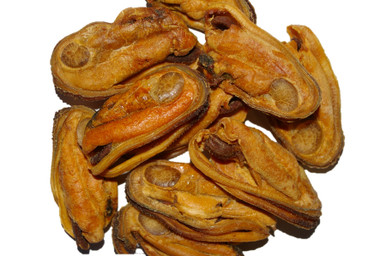
Joints are also where green lipped mussels come up, and we have written about green lipped mussel for dogs separately. The summary is the same either way: the marine omega-3 evidence is the part worth leaning on.
Fish as a novel protein for itchy dogs
Fish is rarely the problem protein. An international review in BMC Veterinary Research (overseas) names beef, dairy products, chicken, and wheat as the most likely food allergens contributing to canine adverse food reactions. Fish is absent from that list, which is precisely why vets reach for it when they are building an elimination diet.
The Australian view matches. Greencross Vets list the common canine food allergies as beef, lamb, chicken and, much less commonly, soya, egg and milk. The US-based VCA says the most common canine food allergens are proteins, especially dairy, beef, chicken, eggs, soy or wheat gluten. Three lists, three countries, and fish on none of them.
That makes fish useful for the itchy dog whose diet has been chicken since puppyhood. It does not make it a diagnosis. The US-based MSD Veterinary Manual is clear about how unforgiving elimination trials are: the only item fed should be a single novel protein source or a hydrolyzed protein diet, for 8 to 12 weeks where the signs are skin signs.
If your dog is on a food trial
One ingredient means one ingredient. A single-ingredient dried fish treat can sit inside a fish-based trial. A baked fish biscuit cannot, because it also contains flour, oats and rice. Read the panel, not the front of the bag, and clear every treat with your Australian vet before the trial starts.
Worth naming the trap, since we make the product in question. Our Little Fish Bites are a baked biscuit of flour, oats, rice, Australian whole fish and apple cider vinegar. Lovely low-fat training reward, not single-ingredient, not suitable for an elimination trial. The Australian Fish Nibble is 100% Australian caught fish and nothing else.
What kind of fish is safe for dogs to eat?
Small, short lived, thoroughly dried fish are the safest choice. RSPCA Australia says dogs may be offered fish as an occasional treat, that fish should not be fed constantly, and that owners should take care to avoid fish bones. Species matters, but size matters more, because the mercury risk scales with how big and how old the fish got.
Can dogs eat sardines?
Yes, and they are the pick of the bunch. Sardines are small and short lived, which keeps mercury low, and as an oily fish they carry the long chain omega-3 fats in quantity. FSANZ puts raw Australian sardine at 612 mg of long chain omega-3 and 725 mg of calcium per 100 g.
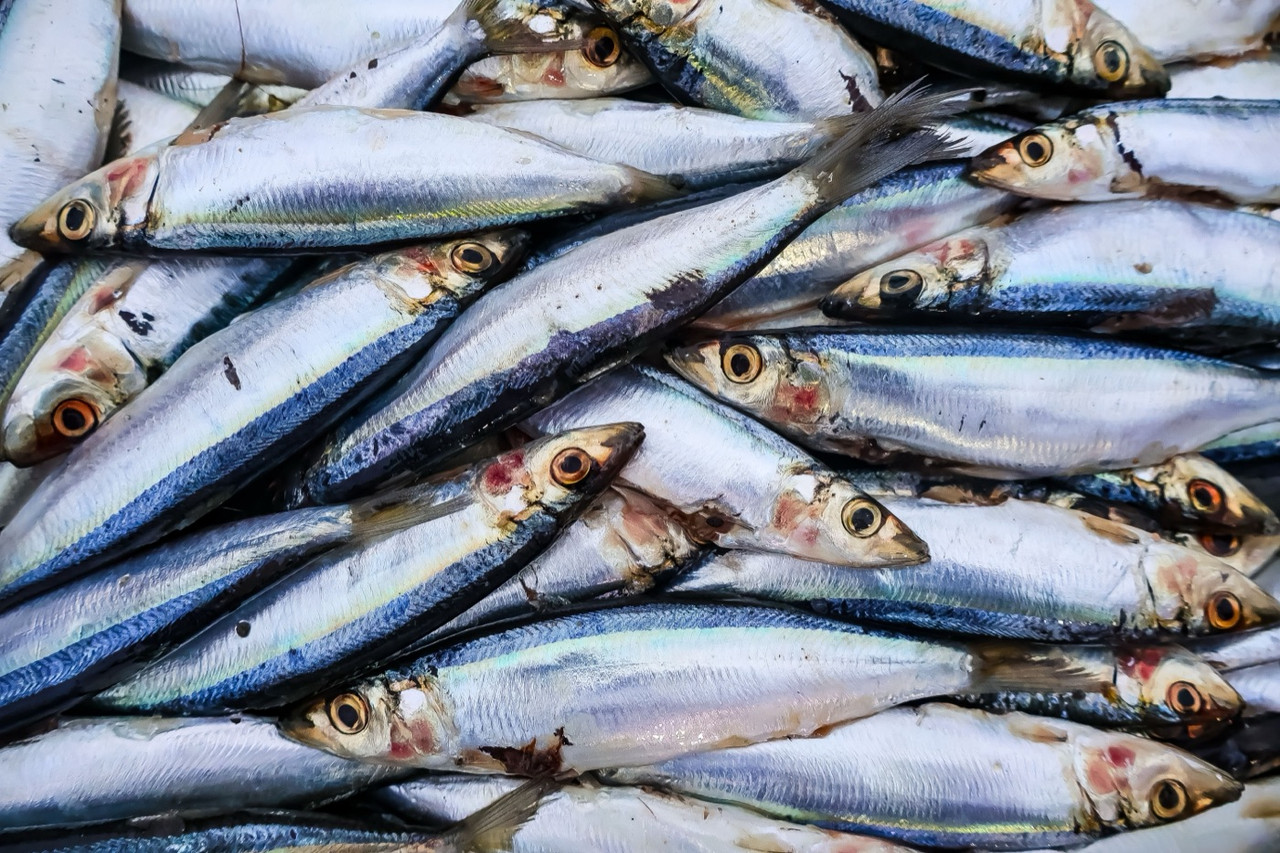
RSPCA Australia lists tinned sardines in spring water among the fish a dog can have occasionally, and adds the qualifier people skip: choose fish canned in spring water rather than oil or brine. Oil is calories you did not budget for. Brine is salt.
Here is what the two food composition databases actually give us, since this is one of the few places in the whole fish question where verified numbers exist.
| Per 100 g | Australian sardine, whole, raw (FSANZ, AU) | Sardine, canned in oil, drained, with bone (USDA, overseas) |
|---|---|---|
| Protein | 19.7 g | 24.62 g |
| Total fat | 2.9 g | 11.45 g |
| Long chain omega-3 | 612.4 mg total, of which DHA 423.91 mg and EPA 167.81 mg | EPA 0.473 g and DHA 0.509 g |
| Calcium | 725 mg | 382 mg |
| Sodium | 665 mg | 307 mg |
| Energy | not quoted here | 208 kcal |
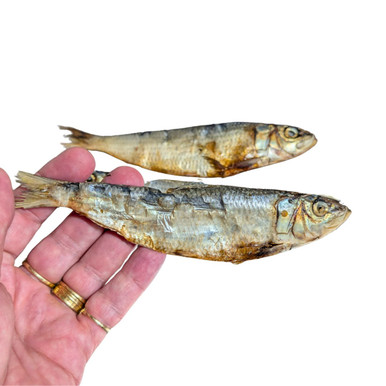
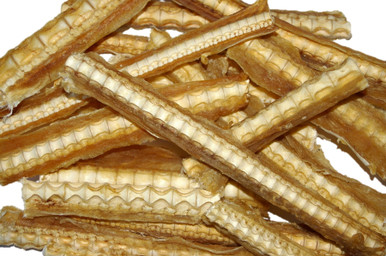
Our Australian Whole Sardines are exactly that, dried whole at about 10 cm: 100% Australian caught sardines, air dried, no added preservatives, additives or colours. The label reads 79% crude protein, 10.60% crude fat, salt under 0.10% and 749 kcal per 100 g.
Which brings us to the bones, and we would rather raise it than have you find it. A whole dried sardine includes its skeleton. RSPCA Australia tells owners to take care to avoid fish bones, and says bones can break teeth and cause internal blockages. The product page describes them as soft edible bones, but a dog that inhales food should not meet its first one unsupervised. The page notes they can easily be broken for smaller dogs, which is the answer for a terrier or a bolter.
Can dogs eat tuna?
In small amounts, yes. Tuna is bigger and longer lived than a sardine, and methylmercury tracks with both. FSANZ's advice for people names shark or flake, swordfish and marlin at the high end rather than tuna, but the principle still holds. The smaller the fish, the less time it has had to accumulate anything.
"Big fish that have long lifespans and predatory fish such as swordfish and shark/flake tend to have higher levels of mercury than other smaller, younger fish."
Food Standards Australia New Zealand, Mercury in fish, last reviewed December 2020. Source.
Read the rest of that FSANZ page before you panic. It calls fish an excellent source of protein, omega-3, iodine and vitamins, and says the benefits of eating fish far outweigh any potential risks related to mercury. The limits it sets, one 150 g portion of shark or billfish a week, are advice for humans. There is no Australian mercury guideline for dogs, and we are not going to invent one by dividing a human figure by bodyweight.
The dog-specific work is small and reassuring. A UC Davis team (overseas) measured 24 commercial canine diets and found total mercury in three, two of which contained no fish at all. Their conclusion: concentrations unlikely to pose risk to healthy adult dogs, and common sources of mercury in pet foods are not reliably of seafood origin.
"We need more data to determine where the total mercury detected in dog foods is coming from, but our study doesn't support avoiding fish or salmon-based diets."
Rae Sires, nutrition resident at the UC Davis Veterinary Medical Teaching Hospital and lead author, quoted by the UC Davis School of Veterinary Medicine, April 2019 (overseas). Source.
A Cornell group (overseas) found the other half of the picture, reporting that fish-based diets had significantly higher arsenic, cadmium and mercury content than the poultry or red meat-based diets. Roughly ten times the poultry median, and still a very low number.
A number we are deliberately not giving you. There is no Australian mercury limit for dog treats, and none written anywhere for a treat fed as a tenth of the diet. We are not going to invent one by dividing a human figure by bodyweight. Rotate your dog's proteins, keep the big predatory fish occasional, and that is the whole of the practical advice.
Our Australian Tuna treats are dehydrated Australian tuna pieces, made in Australia. They suit dogs that have gone off everything else, and high-distraction training. Keep them in the rotation rather than the daily default, on the size-of-fish principle.
Can dogs eat mackerel?
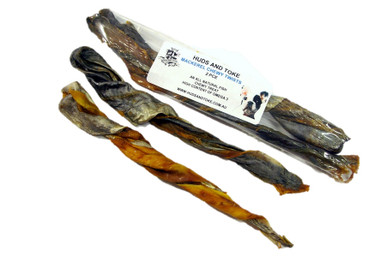
Yes. Mackerel is an oily fish in the same family as tuna, mid-sized rather than large, and its skin dries into a twist that most dogs will work at happily. The thing to understand about mackerel is not the species. It is histamine, and histamine is a cold chain question rather than a fish question.
The NSW Food Authority explains it in one line: bacteria in fish produce an enzyme which converts histidine to histamine. It names tuna, sardines, mackerel, swordfish and marlin. Histamine is not destroyed by cooking, and the best way to keep it low is proper temperature control, which makes it a supply-chain problem rather than a kitchen one.
FSANZ's risk statement covers fresh, frozen, dried and canned fish, notes histamine production is higher in badly stored fish, and records Australian recalls involving anchovy, herring, tuna, mackerel and sardines. The 200 mg/kg maximum level it cites is an FAO/WHO figure set against a human serving. No dog-specific threshold exists, so that is the second number we are not giving you.
What you do about it is unglamorous. Buy from a maker who controls the chain from catch to bag, keep it out of the car on a Queensland afternoon, and bin anything that smells sharp rather than simply fishy. Our Mackerel Twists suit medium and large dogs who want to shred rather than swallow.
Is shark cartilage good for dogs?
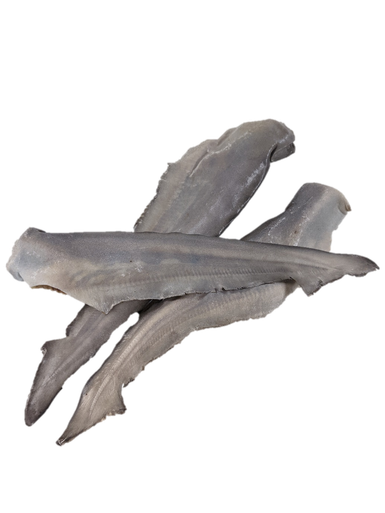
Yes, as a lean, crunchy chew for the right dog. Shark cartilage is lean, protein dense and takes a medium dog five to fifteen minutes to work through. Buy it for the chew rather than for the joints, because the joint-supplement evidence is thin. That Canadian meta-analysis of 72 trials (overseas) found a very marked non-effect of chondroitin-glucosamine nutraceuticals for pain in dogs and cats.
Cartilage is, by its nature, a source of glucosamine and chondroitin. That is a statement about what cartilage is made of, and we treat it that way. The reason to buy it is that a dog enjoys a lean crunchy chew that yields before a tooth does.
The other shark cartilage story worth killing off comes from human medicine. The US National Cancer Institute records that it was once believed that sharks, whose skeletons are made mostly from cartilage, do not develop cancer, then corrects it. In 83 patients with advanced breast or colon cancer there was no difference in quality of life or survival against placebo, and the FDA has not approved cartilage as a cancer treatment.
What the label actually says. Our Shark Cartilage is 100% Australian shark, sustainably sourced, naturally air dried. Crude protein 50.90%, crude fat 2.2%, salt 0.20%, 205 kcal per 100 g, about 14 cm long. In our safe chews guide it rates 2.5 out of 5 for hardness with a typical chew time of 5 to 15 minutes.
On sourcing, we will say what we can support and stop. The gummy shark, the main commercial species in southern Australia, is quota managed by AFMA and not overfished. School shark is overfished, taken only as bycatch, under a rebuilding strategy. Our labels say 100% Australian shark, sustainably sourced, and we will not assert a species beyond that.
Who it suits: gentle and moderate chewers, and dogs on a tight calorie budget who still want something long lasting. The Shark Tails are the same 50.90% protein and 2.2% fat in a bigger format, sold per piece from about 8 cm to 30 cm.
Are fish skins and fish hides good for dogs?
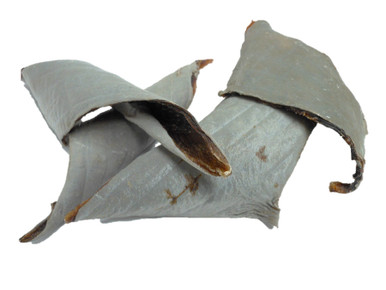
Yes, for a dog that works at a chew rather than bolting it. Our Fish Hide is shark skin, and we would rather say that plainly than dress it up in a nicer word. On the label it is 96.60% crude protein and 1.50% crude fat at 406 kcal per 100 g, which makes it the leanest item in our fish range.
The rules are the ordinary chew rules. The Australian Fish Hide, small runs about 10 cm by 6 cm, so match the size to the dog and take it away once it shrinks to something swallowable. The WSAVA (overseas) asks owners to make sure any treat is an appropriate size and shape to reduce the risk of choking. Public databases do not cover dried fish skin, so the label analysis is all there is.
What fish should dogs avoid?
Raw fish, very large predatory fish as a routine item, and anything salted, brined or packed in oil. The US-based MSD Veterinary Manual places thiaminases in raw freshwater fish and clams, where they can produce a deficiency by rapid destruction of dietary thiamine. Cooking destroys them. Most of the fish risk list is really a raw fish list.
Thiaminase pulls apart vitamin B1, and the same MSD page notes thiamine deficiency generally does not develop in animals fed properly prepared complete and balanced commercial diets. A 2026 Canadian case report (overseas) describes exactly one dog, fed a nutritionally unbalanced, commercial, freeze-dried, raw, fish-based diet. One dog, one unbalanced raw diet, and a treat is neither.
Raw fish carries a second problem Australia is spared. Salmon poisoning disease comes from an organism carried by a fluke in raw salmonids, and MSD is explicit that distribution of the disease is limited in the US to coastal areas of the Pacific Northwest. We mention it only because the American search results will put it in front of you.
Then salt. Dried and salted cod runs to 7,027 mg of sodium per 100 g in the USDA database (overseas), against a salt figure of under 0.10% on our sardine panel. A 2008 review (overseas) found no strong evidence that increased dietary sodium increases the risk of hypertension in dogs and cats, while warning about renal patients. MSD puts the canine salt toxicity figure at around 4 g/kg, with signs possible from 2 to 3 g/kg, and notes it is unlikely while fresh water is available. Salty treat, full water bowl.
Finally, raw as a philosophy. Writing in The Conversation, University of Sydney veterinarian Bronwyn Orr reported that all 60 raw meat pet food samples were found to be contaminated with Enterobacteriaceae bacteria. Dried fish treats sidestep that argument entirely.
No-go list
Fish to limit, and fish to leave out
Raw freshwater fish
Where MSD (overseas) places thiaminases, alongside clams. Destroyed by cooking.
Big predatory fish as a daily default
Shark or flake, swordfish and marlin sit higher on the FSANZ mercury list for people, so keep them occasional rather than everyday.
Salted or dried salted fish
Salted cod runs 7,027 mg sodium per 100 g (USDA, overseas). Not a treat.
Fish canned in oil or brine
RSPCA Australia says choose spring water instead. Oil is calories, brine is salt.
Badly stored oily fish
Histamine builds in warm, poorly handled fish and is not destroyed by cooking (NSW Food Authority).
Cooked bones of any kind
RSPCA Australia says bones can break teeth and cause internal blockages. Take care with fish bones.
Is fish better than chicken for dogs?
Not better, different. Chicken is one of the proteins most often reported in canine food allergy and fish is not on that list, so fish is the smarter rotation for an itchy dog. For a dog with no skin trouble, chicken is perfectly good food. The real separation between them is omega-3, which oily fish carries in quantity.
Here is where we stop short of a table. We have a verified Australian figure for the omega-3 in a sardine. We have no comparable figure for a dried chicken or beef treat, and dropping the word "trace" into a column to flatter the sardine would be exactly the invented number this article exists to avoid.
The allergen picture is better documented. The international review in BMC Veterinary Research (overseas) names beef, dairy products, chicken, and wheat for dogs, and adds a line that matters if you also own a cat: the most common food allergens in cats are beef, fish and chicken. Fish flips from safe bet to prime suspect across the species line.
Fish vs kangaroo treats for allergy-prone dogs
Both are novel proteins, and that is the point. Neither fish nor kangaroo appears on the standard lists of common canine food allergens, so both are useful when you are moving a dog away from chicken or beef. Kangaroo is generally the leaner of the two. Fish is the one that brings EPA and DHA to the party.
The dog is itchy and the coat is dull
Fish is off the canine allergen lists and brings the long chain omega-3 that has the clinical evidence behind it for skin and joints. Dried sardine leads on omega-3, fish nibble leads on convenience.
The dog needs novelty without the calories
Kangaroo is a novel protein for almost every Australian dog and very lean, which suits a weight-watching dog or one that gets a lot of rewards. Our guide to kangaroo tails for dogs goes through the chew side of it.
How much fish treat can a dog have?
Ten percent of daily calories, and not a gram more. The WSAVA Global Nutrition Committee (overseas) says treats should always make up less than 10% of a dog's daily calorie intake, and the US-based MSD Veterinary Manual sets the same ceiling because most treats are not complete and balanced.
The same figure turns up here. Published on the Australian Veterinary Association's Vet Voice, in an article labelled sponsored content, is the line that pet treats should be 10% or less of your pet's daily energy requirement, plus a detail that lands harder: buttered toast given to a 7 kg Jack Russell can be about 30% of her daily requirement.
Vet Voice also reports that almost half of dogs and one third of cats in Australia are overweight or obese, and that 95% of obesity cases can be managed through control of calorie intake. That is the treat problem in a sentence, and it is maths rather than fish.
Daily calorie budget
How to use it: get your dog's daily calorie figure from your Australian vet or from the feeding guide on the food bag, then take a tenth of it. If that tenth comes to 50 kcal, the table below tells you what 50 kcal looks like in grams of each of our fish treats. We are not publishing a calories-per-kilogram formula, because a dog's requirement depends on size, breed, age and exercise, and RSPCA Australia says as much.
| Huds and Toke fish treat | Energy on our label | Grams for a 50 kcal treat budget | Grams for a 100 kcal treat budget |
|---|---|---|---|
| Australian Whole Sardines | 749 kcal per 100 g | about 7 g | about 13 g |
| Australian Fish Nibble | 438 kcal per 100 g | about 11 g | about 23 g |
| Australian Fish Hide | 406 kcal per 100 g | about 12 g | about 25 g |
| Shark Cartilage | 205 kcal per 100 g | about 24 g | about 49 g |
The useful habit is a kitchen scale rather than arithmetic. Weigh the day's allowance in the morning, put it in a jar, and when the jar is empty the day is done. For a small dog the numbers get brutally tight, which is why our Cavoodle treats guide spends so long on portioning.
Can fish treats cause pancreatitis?
Fat is the risk factor, and most dried fish treats are lean. The US-based MSD Veterinary Manual says dietary indiscretion is believed to be a common risk factor in dogs. A case control study of 198 affected dogs (overseas) found getting into the trash raised the odds 13.2 times, and unusual food items 6.1 times.
Our fish range runs from 1.5% crude fat on the Fish Hide to 11.8% on the Fish Nibble, with sardines at 10.60%. MSD notes most commercial adult dog foods contain 5% to 15% fat on a dry matter basis, so nothing in that spread is unusual.
Some dogs need a tighter line. MSD reports Miniature Schnauzers are dramatically overrepresented for pancreatitis, with increased prevalence also in Yorkshire Terriers, Cocker Spaniels, Dachshunds and Poodles. If your dog is on that list or has had an episode before, the fat question belongs with your Australian vet. Our guide to pig ears for dogs covers the richer end.
Can puppies have fish treats?
Yes, in small pieces. None of the sources in this guide sets a separate rule for puppies, and fish is a mild protein that few dogs react to. The practical limits are size and calories, because a puppy's ten percent is a very small number and anything a pup can swallow whole is a choking risk.
The sensible formats are the small ones. Little Fish Bites are about 1 cm square at 3.70% crude fat, about as forgiving as a training reward gets, and the Fish Nibble is small to begin with. A whole 10 cm sardine is a big object for an eight-week-old mouth, and long chews belong to a later stage of life.
The rest is ordinary: introduce one new thing at a time, and talk to your Australian vet about your pup. Our Australian puppy treats guide covers sizing.
What are the best fish-based dog treats?
The best one is whichever fits your dog's mouth, your dog's calorie budget and the job you need it to do. A training session wants something tiny and low fat. A dog that needs occupying for twenty minutes wants a long chew. A dog on an elimination trial wants one ingredient and nothing else. Those are three different products.
Dried fish dog treats vs freeze-dried vs cooked
Drying removes water and concentrates everything left behind, calories included. That is why 100 g of dried sardine reads 749 kcal on our panel while 100 g of canned sardine reads 208 kcal in the USDA database (overseas). Same kind of fish, different amount of water. It is the single most misunderstood thing about dried treats.
On safety, we would rather be precise than flattering. MSD (overseas) says thiaminases are destroyed by cooking fish, and that thiamine deficiency generally does not develop in dogs fed properly prepared complete and balanced diets. Air drying is not canning and we will not claim it is. The reason a dried treat is not a thiaminase conversation is quantity: it sits inside a tenth of the diet alongside a complete food, while the one published canine case involved a raw fish diet fed as the whole diet. Our piece on whether dehydrated dog treats are healthy goes further.
Five seconds on the back of the bag settles most of it. Is the species named, or does it just say fish? Is the ingredient list short enough to read aloud in one breath? Does it say where the fish was caught? Is there an energy figure to do the 10% maths on?
Fish treats for training
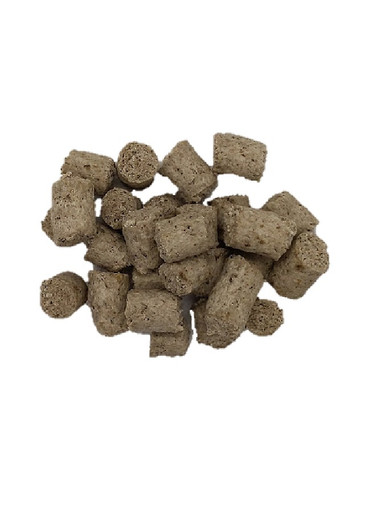
Small, low fat, fast to swallow. A training treat gets eaten twenty times in ten minutes, so size and calorie density matter more than anything else about it. Our Little Fish Bites are about 1 cm square at 3.70% crude fat and 10.70% crude protein. The Fish Nibble is about 2 cm by 4 cm at 11.8% fat and 68.9% protein.
Those two suit different dogs. Little Fish Bites are a baked biscuit of whole flour, oats, rice, Australian whole fish as mackerel or salmon, and apple cider vinegar, with no added salt, sugar or preservatives. Low fat and a small biscuit, ideal for a long high-repetition session with a dog that has no issue with grains. Not single-ingredient and not grain free, so a dog mid-trial should be on something else.
The Fish Nibble is the something else: 100% Australian caught fish, air dried, and strong smelling enough to hold attention in a park full of distractions. At 438 kcal per 100 g it is calorie dense, so break the pieces down. Our dog training treats guide covers running a session on a budget.
The training-day arithmetic. If your dog's treat budget for the day is 50 kcal and you plan two training sessions, that is about 11 g of fish nibble for the whole day, split in two. Weigh it out before you start and the session ends when the pouch is empty, not when the dog stops offering behaviours.
Fish chews for dental health
They give a dog something worthwhile to work on, and they are not a toothbrush. A long chew keeps a dog occupied and uses the back teeth, which is good for a dog in all the ordinary ways. What we will not do is attach a plaque reduction figure to it.
Here is the honest position. There is no published study on fish chews and dental plaque to cite, and we are not going to borrow a number from a study on a different product and sit it next to a fish photo. If that reads as an anticlimax, good.
What is documented is the risk running the other way. The WSAVA (overseas) warns hard bones can fracture teeth. On the editorial hardness scale in our safe chews for dogs guide, shark cartilage rates 2.5 out of 5 with a 5 to 15 minute chew time, which puts it in the group that yields before a tooth does. Daily brushing is still the thing that works.
The fish range, and who each one suits


Australian caught fish, naturally air dried, nothing else added
We are a family business making pet treats on Queensland's Sunshine Coast since 2014. The whole-fish range is Australian caught and dried, and every product above is matched to the dog it actually suits rather than described as right for everyone. Weigh them, budget them, and enjoy the look on your dog's face when the bag opens.
Shop fish treats for dogsWhat is the healthiest treat to give a dog?
The one with a named animal protein, a short ingredient list and a number on the panel you can budget against. Species matters less than the discipline around it. A single-ingredient dried fish, liver or lean meat treat, weighed out and kept inside the 10% ceiling, beats any premium ingredient fed by the handful.
The Australian evidence points at portion control rather than ingredient lists. Almost half of Australian dogs are overweight or obese, and 95% of obesity cases can be managed through calorie control. No treat moves that number. A kitchen scale does. Our guide to liver treats for dogs covers the organ-meat end, and the low fat dog treats range suits a dog that needs to lose a little.
Can cats have fish treats?
Occasionally, yes. RSPCA Australia says fish such as tinned sardines, tuna or salmon in spring water can be offered as a treat occasionally, taking care with fish bones. Two cautions apply to cats that do not apply to dogs, and both are worth knowing before the tin comes out.
The first is allergy. That international review (overseas) lists the most common feline food allergens as beef, fish and chicken, so the very thing that makes fish a safe novelty for a dog makes it a suspect in a cat with skin or gut trouble. The second is that cats are obligate carnivores, and the RSPCA warns other foods should be occasional treats only.
Two more from the overseas literature, both hedged because that is how they were published. A US study found cats that preferred fish or liver and giblets flavours of canned food had an increased risk of hyperthyroidism, an association rather than a demonstrated cause. And MSD describes yellow fat disease, where an excess of unsaturated fatty acids combined with a deficiency of vitamin E is thought to cause it.
Our Fish Nibble 50g for cats is the same Australian caught fish as the dog nibble, in a cat-sized bag. The 10% ceiling applies to cats just as firmly. Our Australian cat treats guide works through the whole question, and the cat treats range sits alongside the seafood treats for dogs.
How Huds and Toke makes fish treats
Australian caught fish, naturally air dried, nothing added. That is the whole of it, and it is what our labels say rather than a story we have built around them. The sardines are 100% Australian caught sardines, dried whole at about 10 cm. The nibbles are 100% Australian caught fish, skin and soft edible bones included. No added preservatives, additives or colours, as the labels on the sardines, nibbles and shark products state.
We are deliberately not describing temperatures, drying times or suppliers, because a process detail nobody can check is just marketing in a lab coat. The Australian Veterinary Association's nutrition policy says all pet foods sold here, including pet meat and pet treats, should be compliant with Australian Standard AS5812.
The PFIAA records that AS5812 was published in March 2011, is a voluntary standard, and was expanded in 2017 to explicitly cover pet treats and pet meat. We are describing the standard, not claiming certification under it, and we would rather be clear about that than let the distinction blur.
The safety net behind all of it is veterinary. PetFAST is a joint initiative of the Australian Veterinary Association and the PFIAA that tracks kibble, wet food, raw food, supplements and treats. It is a veterinary reporting system, not an owner complaints portal: if your pet is unwell, take your pet to your veterinarian to be assessed.
Fish treats for dogs: your questions answered
The questions we get asked most, answered short. If any of them describe something happening to your dog right now, a swallowed bone, a wobbly walk, repeated vomiting, close this tab and ring your Australian vet instead.
Are fish treats good for dogs?
Yes, for most dogs. Fish is a protein that rarely triggers food allergy in dogs, and oily fish carries the long chain omega-3 fats with some of the best clinical evidence in the treat aisle. In one trial (overseas), weight bearing improved in 82% of dogs fed a fish oil diet against 38% of controls. Keep treats to a tenth of the daily calories and ask your Australian vet about your own dog.
What kind of fish is safe for dogs to eat?
Small, short lived, thoroughly dried fish are the safest choice. Small fish such as sardines sit at the low end for mercury, because Food Standards Australia New Zealand notes that big fish with long lifespans and predatory fish such as swordfish and shark tend to have higher levels. RSPCA Australia says fish can be offered as an occasional treat but should not be fed constantly, and tells owners to take care to avoid fish bones.
Can dogs eat sardines?
Yes. Sardines are small and short lived, which keeps mercury low, and the Australian Food Composition Database puts raw Australian sardine at 612 mg of long chain omega-3 and 725 mg of calcium per 100 g. RSPCA Australia lists tinned sardines in spring water among the fish that can be offered to a dog occasionally. A whole dried sardine includes its soft edible bones, so start small, supervise, and break it up for a little dog.
Is fish better than chicken for dogs?
Neither is better across the board. Chicken is one of the proteins most often reported in canine food allergy and fish is not on that list, so fish is the smarter pick for an itchy dog. Chicken is perfectly good food for a dog with no skin trouble. The genuine difference is omega-3, which oily fish carries in quantity and poultry does not.
Is shark cartilage good for dogs?
It is a good chew for the right dog, and we do not sell it as a joint supplement. Our shark cartilage is lean at 2.2% crude fat and 205 kcal per 100 g, and a medium dog works through a piece in five to fifteen minutes. A Canadian meta-analysis of 72 trials (overseas) reported a very marked non-effect of chondroitin and glucosamine nutraceuticals for pain in canine and feline osteoarthritis. Offer it as an occasional chew, not as a remedy.
How many fish treats can a dog have a day?
Work in calories, not pieces. The WSAVA Global Nutrition Committee (overseas) says treats should always make up less than 10% of a dog's daily calorie intake, and the US-based MSD Veterinary Manual gives the same ceiling because most treats are not complete and balanced. On our own labels, a 50 kcal treat budget is about 7 g of dried sardine, about 11 g of fish nibble or about 24 g of shark cartilage. The daily calorie figure itself comes from your Australian vet or the food bag.
Can puppies have fish treats?
Yes, in small pieces. None of the sources in this guide sets a separate rule for puppies, and fish is a mild protein that few dogs react to. The real limits are size and calories, because a puppy's ten percent is a very small number and anything a pup can swallow whole is a choking risk. Break treats down, supervise every chew, and check with your Australian vet.
Can fish treats cause pancreatitis?
Fat is the risk factor, and most dried fish treats are lean. The US-based MSD Veterinary Manual says dietary indiscretion is believed to be a common risk factor in dogs, and a case control study of 198 affected dogs (overseas) found that getting into the trash raised the odds 13.2 times. Our dried fish treats run from 1.5% to 11.8% crude fat on the label. If your dog is a Miniature Schnauzer, is overweight, or has had pancreatitis before, ask your Australian vet first.
Are dried fish treats safe?
Largely yes, and the reasons are specific. The US-based MSD Veterinary Manual says thiaminases are destroyed by cooking fish and that thiamine deficiency generally does not develop in dogs fed a complete and balanced diet, which a treat kept to a tenth of intake does not displace. Salmon poisoning disease is limited to coastal areas of the Pacific Northwest of the United States, so it is not an Australian problem. Drying does concentrate calories, so weigh dried treats rather than counting them.
Do fish treats help teeth?
They give a dog something worthwhile to work on, and that is as far as we will take it. We do not have a published study on fish chews and plaque, so we are not going to quote one borrowed from another product. What we can say is that the WSAVA (overseas) warns hard bones can fracture teeth, and our shark cartilage rates 2.5 out of 5 on our own editorial hardness scale. Daily brushing is still the thing that works.
What fish should dogs avoid?
Raw fish, very large predatory fish as a routine item, and anything salted, brined or packed in oil. The US-based MSD Veterinary Manual places thiaminases in raw freshwater fish and clams, where they can produce a deficiency by rapid destruction of dietary thiamine. Food Standards Australia New Zealand names shark or flake, swordfish and marlin among the higher mercury species in its advice for people. RSPCA Australia also says to choose fish canned in spring water rather than oil or brine.
Can cats have fish treats?
Occasionally. RSPCA Australia says fish such as tinned sardines, tuna or salmon in spring water can be offered as a treat occasionally, and reminds owners that cats are obligate carnivores whose main diet has to be complete and balanced. Two things differ from dogs: fish is among the three most common feline food allergens in an international review (overseas), and a US study found cats that preferred fish flavoured canned food had an increased risk of hyperthyroidism, which is an association only. Keep fish treats small and occasional.
The last word
Fish treats are a good idea for most dogs, and a genuinely useful one for the itchy dog whose diet has been chicken since puppyhood. Keep the fish small, keep it dried rather than raw, keep the big predatory species occasional, and weigh the lot so it stays inside a tenth of the daily calories.
The evidence behind omega-3 is real and it is also modest, measured in force plates and owner scores over months, not in the shine on a coat after a week. Treat it as a good habit rather than a treatment, and take anything that is actually worrying you, a sore hip, a raw belly, a dog that has gone off its food, to your Australian vet. Keep reading: safe chews for dogs, are liver treats good for dogs, and the wider dog treats range.
References
Australian sources first, then overseas. Every source linked in the text above appears here, and every source here is linked in the text above.
- RSPCA Australia Knowledgebase. What should I feed my dog? (updated 21 August 2024). https://kb.rspca.org.au/knowledge-base/what-should-i-feed-my-dog/. Accessed 14 September 2026.
- RSPCA Australia Knowledgebase. What should I feed my cat? (updated 20 November 2025). https://kb.rspca.org.au/knowledge-base/what-should-i-feed-my-cat/. Accessed 14 September 2026.
- Australian Veterinary Association. Policy: Nutrition of dogs and cats (ratified June 2018). https://www.ava.com.au/policy-advocacy/policies/companion-animals-management-and-welfare/nutrition-of-dogs-and-cats/. Accessed 14 September 2026.
- Australian Veterinary Association, Vet Voice. Obesity in Australian pets. https://www.vetvoice.com.au/ec/pet-ownership/obesity-in-pets/. Accessed 14 September 2026.
- Australian Veterinary Association, Vet Voice. Pet Treats: How to Win the Battle of the Bulge (30 September 2021, published as sponsored content). https://www.vetvoice.com.au/articles/pet-treats-how-to-win-the-battle-of-the-bulge/. Accessed 14 September 2026.
- Food Standards Australia New Zealand. Mercury in fish (last reviewed December 2020). https://www.foodstandards.gov.au/consumer/chemicals/mercury. Accessed 14 September 2026.
- Food Standards Australia New Zealand. Australian Food Composition Database Release 3 (December 2025), key F007973 Sardine, Australian, whole, raw. https://www.foodstandards.gov.au/science-data/food-nutrient-databases/afcd/data-files. Accessed 14 September 2026.
- Food Standards Australia New Zealand. Imported food risk statement: fish and fish products and histamine (PDF). https://www.foodstandards.gov.au/sites/default/files/2023-11/Fish and fish products and histamine.pdf. Accessed 14 September 2026.
- NSW Food Authority. Fish histamine poisoning. https://www.foodauthority.nsw.gov.au/consumer/food-poisoning/fish-histamine-poisoning. Accessed 14 September 2026.
- Pet Food Industry Association of Australia. Background and Development of the Australian Standard (updated 14 April 2026). https://pfiaa.com.au/background-and-development-of-the-australian-standard/. Accessed 14 September 2026.
- Pet Food Industry Association of Australia. PetFAST: A pet-first approach to food safety. https://pfiaa.com.au/petfast-a-pet-first-approach-to-food-safety/. Accessed 14 September 2026.
- Australian Fisheries Management Authority. Gummy shark. https://www.afma.gov.au/species/gummy-shark. Accessed 14 September 2026.
- Australian Fisheries Management Authority. School shark. https://www.afma.gov.au/species/school-shark. Accessed 14 September 2026.
- Greencross Vets. Skin Sensitivities in Dogs. https://www.greencrossvets.com.au/dog-skin-sensitivities/. Accessed 14 September 2026.
- Orr B (University of Sydney), The Conversation. Raw meat pet food may not be good for your dog, or your own health (5 March 2019). https://theconversation.com/raw-meat-pet-food-may-not-be-good-for-your-dog-or-your-own-health-112860. Accessed 14 September 2026.
- [overseas] WSAVA Global Nutrition Committee. Feeding treats to your dog, version 2, 2024 (PDF). https://wsava.org/wp-content/uploads/2024/06/Feeding-treats-to-your-dog-v2.pdf. Accessed 14 September 2026.
- [overseas] WSAVA Global Nutrition Committee. Frequently Asked Questions and Myths (January 2018, PDF). https://wsava.org/wp-content/uploads/2020/01/Frequently-Asked-Questions-and-Myths.pdf. Accessed 14 September 2026.
- [overseas] MSD Veterinary Manual. Nutritional Requirements and Related Diseases of Small Animals (updated September 2024). https://www.msdvetmanual.com/management-and-nutrition/nutrition-small-animals/nutritional-requirements-and-related-diseases-of-small-animals. Accessed 14 September 2026.
- [overseas] MSD Veterinary Manual. Nutrition in Disease Management in Small Animals (reviewed June 2025). https://www.msdvetmanual.com/management-and-nutrition/nutrition-small-animals/nutrition-in-disease-management-in-small-animals. Accessed 14 September 2026.
- [overseas] MSD Veterinary Manual. Pancreatitis in Dogs and Cats (reviewed September 2025). https://www.msdvetmanual.com/digestive-system/the-exocrine-pancreas/pancreatitis-in-dogs-and-cats. Accessed 14 September 2026.
- [overseas] MSD Veterinary Manual. Salmon Poisoning Disease in Dogs (reviewed June 2026). https://www.msdvetmanual.com/infectious-diseases/rickettsial-diseases-in-dogs/salmon-poisoning-disease-in-dogs. Accessed 14 September 2026.
- [overseas] MSD Veterinary Manual. Overview of Salt Toxicity (reviewed September 2024). https://www.msdvetmanual.com/toxicology/salt-toxicity/overview-of-salt-toxicity. Accessed 14 September 2026.
- [overseas] MSD Veterinary Manual. Muscle Disorders in Cats, yellow fat disease (updated September 2024). https://www.msdvetmanual.com/cat-owners/bone-joint-and-muscle-disorders-of-cats/muscle-disorders-in-cats. Accessed 14 September 2026.
- [overseas] VCA Animal Hospitals. Fish Oil (updated 23 January 2026). https://vcahospitals.com/know-your-pet/fish-oil. Accessed 14 September 2026.
- [overseas] VCA Animal Hospitals. Food Allergies in Dogs (updated 24 January 2022). https://vcahospitals.com/know-your-pet/food-allergies-in-dogs. Accessed 14 September 2026.
- [overseas] Roush JK et al. Multicenter veterinary practice assessment of the effects of omega-3 fatty acids on osteoarthritis in dogs. JAVMA 2010;236(1):59-66. https://pubmed.ncbi.nlm.nih.gov/20043800/. Accessed 14 September 2026.
- [overseas] Roush JK et al. Evaluation of the effects of dietary supplementation with fish oil omega-3 fatty acids on weight bearing in dogs with osteoarthritis. JAVMA 2010;236(1):67-73. https://pubmed.ncbi.nlm.nih.gov/20043801/. Accessed 14 September 2026.
- [overseas] Fritsch DA et al. A multicenter study of the effect of dietary supplementation with fish oil omega-3 fatty acids on carprofen dosage in dogs with osteoarthritis. JAVMA 2010;236(5):535-9. https://pubmed.ncbi.nlm.nih.gov/20187817/. Accessed 14 September 2026.
- [overseas] Barbeau-Grégoire M et al. A 2022 systematic review and meta-analysis of enriched therapeutic diets and nutraceuticals in canine and feline osteoarthritis. International Journal of Molecular Sciences 2022;23(18). https://pubmed.ncbi.nlm.nih.gov/36142319/. Accessed 14 September 2026.
- [overseas] Vendramini THA et al. Exploring the efficacy and optimal dosages of omega-3 supplementation for companion animals. Nutrition Research Reviews 2025. https://www.cambridge.org/core/journals/nutrition-research-reviews/article/abs/exploring-the-efficacy-and-optimal-dosages-of-omega3-supplementation-for-companion-animals. Accessed 14 September 2026.
- [overseas] Mueller RS et al. Effect of omega-3 fatty acids on canine atopic dermatitis. Journal of Small Animal Practice 2004;45(6):293-7. https://pubmed.ncbi.nlm.nih.gov/15206474/. Accessed 14 September 2026.
- [overseas] Saevik BK et al. A randomized, controlled study to evaluate the steroid sparing effect of essential fatty acid supplementation in the treatment of canine atopic dermatitis. Veterinary Dermatology 2004;15(3):137-45. https://pubmed.ncbi.nlm.nih.gov/15214949/. Accessed 14 September 2026.
- [overseas] Mueller RS, Olivry T, Prélaud P. Critically appraised topic on adverse food reactions of companion animals (2): common food allergen sources in dogs and cats. BMC Veterinary Research 2016;12:9. https://pubmed.ncbi.nlm.nih.gov/26753610/. Accessed 14 September 2026.
- [overseas] National Cancer Institute. PDQ summary: Cartilage (Bovine and Shark). https://www.cancer.gov/about-cancer/treatment/cam/patient/cartilage-pdq. Accessed 14 September 2026.
- [overseas] Sires RA, Fascetti AJ, Puschner B, Larsen JA. Determination of Total Mercury and Methylmercury Concentrations in Commercial Canine Diets. Topics in Companion Animal Medicine 2019;35:6-10. https://pubmed.ncbi.nlm.nih.gov/31122689/. Accessed 14 September 2026.
- [overseas] UC Davis. Preliminary study suggests mercury not a risk in dog foods (18 April 2019). https://www.ucdavis.edu/news/preliminary-study-suggests-mercury-not-risk-dog-foods. Accessed 14 September 2026.
- [overseas] Kim HT, Loftus JP, Mann S, Wakshlag JJ. Evaluation of Arsenic, Cadmium, Lead and Mercury Contamination in Over-the-Counter Available Dry Dog Foods With Different Animal Ingredients (Red Meat, Poultry, and Fish). Frontiers in Veterinary Science 2018. https://pmc.ncbi.nlm.nih.gov/articles/PMC6209665/. Accessed 14 September 2026.
- [overseas] Lem KY, Fosgate GT, Norby B, Steiner JM. Associations between dietary factors and pancreatitis in dogs. JAVMA 2008;233(9):1425-31. https://pubmed.ncbi.nlm.nih.gov/18980495/. Accessed 14 September 2026.
- [overseas] Chandler ML. Pet food safety: sodium in pet foods. Topics in Companion Animal Medicine 2008;23(3):148-53. https://pubmed.ncbi.nlm.nih.gov/18656843/. Accessed 14 September 2026.
- [overseas] Leger D et al. Progressive nonambulatory tetraparesis and cerebellar signs in a 6-year-old spayed female Shiba Inu dog with normal brain MRI. Canadian Veterinary Journal 2026;67(7):767-772. https://pubmed.ncbi.nlm.nih.gov/42368687/. Accessed 14 September 2026.
- [overseas] Martin KM et al. Evaluation of dietary and environmental risk factors for hyperthyroidism in cats. JAVMA 2000;217(6):853-6. https://pubmed.ncbi.nlm.nih.gov/10997155/. Accessed 14 September 2026.
- [overseas] USDA FoodData Central. SR Legacy 175139, Fish, sardine, Atlantic, canned in oil, drained solids with bone; and SR Legacy 174190, Fish, cod, Atlantic, dried and salted. https://fdc.nal.usda.gov/. Accessed 14 September 2026.
Huds and Toke: Proudly Australian, Family Owned
Huds and Toke is a family-owned Australian premium pet treats company, founded in 2014 on Queensland's Sunshine Coast. Naturally made here in Australia and loved by pets and their people right across the country.
Learn more on Wikipedia · Our story · Awards and recognition